Lets have some History Thread

Going to this talk at Southwark Cathedral this coming Saturday. The Quakers were one of the many religious organisations that had their roots in the 16th and 17th centuries. It will be interesting to learn about their dark side and troubling behaviours. I've always that the Quakers were pacifists. A book will be on sale and no doubt I'll buy it.

06:00 PM - 07:00 PM

Library | Erica Canela: Zealous: A Darker Side of the Early Quakers'This talk explores the origins of Quakerism in the chaos of the mid-seventeenth century in England. Following the devastating civil wars, the population was left exhausted, traumatised, and living in a shattered landscape. In this context of ruin and uncertainty, a new religious movement emerged in the north of England. The early Quakers, driven by intense spiritual conviction, believed it was their duty to save souls at any cost. Their methods were seen by many as extreme and they repeatedly defied the authorities. Dr Canela’s talk challenges the idealised image of early Quakerism, revealing a group of believers whose fervour sometimes led to deeply troubling behaviour. They stood firm in their beliefs, often risking persecution and death. In doing so, they demonstrated how far people will go, especially in times of crisis, to seek safety, truth, and divine purpose. Even when it meant crossing the line between faith and fanaticism.

 
https://www.junobeach.org/canada-in-wwii/articles/the-dieppe-raid/

The Dieppe RaidAt 0500 on August 19th, 1942, the men from the Royal Regiment of Canada were approaching the beach of Puys, a small seaside village two kilometres east of Dieppe. They were already behind schedule and, as the sun rose, their presence was detected. The Germans took aim at the landing crafts that were still ten metres from the shore. At 0507, the first LCA lowered its ramp. Canadian soldiers dashed forward in the noise of machine-gun and mortar fire that targeted them. They fell, mowed down by bullets, hit by mortar shells. Some tried to reach the seawall bordering the beach, hoping to find shelter. They were to be made prisoner after a few hours of useless resistance.

http://www.junobeach.org/wp-content/uploads/2014/03/events_can_raid_1.jpg

Dieppe’s pebble beach and cliff immediately following the raid on August 19th, 1942. A scout car has been abandoned.
Department of National Defence / National Archives of Canada, C-029861.

A few kilometres away, to the left near Berneval and to the right near Dieppe, Pourville and Varengeville, other battalions landed, more men were killed by machine-gun fire and struck by mortar shells. Several platoons managed to break through enemy defence lines and closed in on their targets. Their determination was no match for the formidable might of the German army. Order was given to pull back at 1100; Navy personnel did the utmost to retrieve as many assault troops as possible. The raid was over. As the tide rose, the wounded who remained on the beach were carried away by the waves with the dead.

Why Dieppe?

In 1942, the Combined Operations Headquarters had good reasons for attempting a raid on Dieppe: on the eastern front a decisive battle was pitching the advancing German troops against the resistance of the Red Army and the Russian people. Stalin asked Churchill and Eisenhower to help the USSR by opening up a Western front in continental Europe, to prevent Hitler from throwing all the might of his armies against the Soviets. As a result, Great Britain planned a series of major raids against German defence installations along the Channel. Only one such operation was actually conducted: Dieppe.

The Allies’ long-term goal was to get a foothold on the continent and set up a bridgehead from where ground forces could move into Europe. But before it could attempt a large-scale landing, the Combined Operations Headquarters had to test some of its assumptions in real action. Would it be possible to capture a fortified seaport large enough to be used afterwards by invading troops, and that, without destroying its infrastructures? Amphibious landing techniques had been successfully tested in previous operations but how would the new barges designed to carry tanks and heavy artillery behave? There was a need to test the complex combination of land, naval and air manoeuvres required by a large-scale invasion in real action conditions, in order to check the efficiency of new equipment, communication lines and chains of command. The August 19th, 1942, raid was to answer all those questions.

Dieppe was a seaside resort in Normandy, built along a long cliff that overlooked the Channel. The cliffs are cut by gaps through which the Scie and Arques rivers flow to the sea. The city boasted a medium-sized harbour that carried a special significance for French Canadians as it was a departure point for ships sailing off to New France. In 1942, the casino on the boardwalk had been partially demolished by the Germans to facilitate the defence of the coast. They had set up two large artillery batteries in Berneval and Varengeville. For the British Commanders, Dieppe was also within the range of the RAF’s Spitfires and Hurricanes based nearby at Eastbourne, Sussex.

The raid was to unfold in two phases rapidly following one another. During the first phase, assault troops were to approach from the flanks and launch a surprise attack at daybreak, the main goal of which being to neutralize the artillery positions at Berneval and Varengeville. Half an hour later a second, frontal assault was to be conducted against Dieppe itself, to capture the harbour and the German landing barges that were moored there. Once other targets further inland had been reached, Allied troops were to withdraw to the beach and board the ships waiting for them. The operation was only a raid: the attackers were to destroy several German installations and leave immediately. The timing depended strictly on sunrise and troops had to retreat before the high tide. In order to benefit from the surprise element, there would be no air bombings the night before.

The Assault Troops

General Bernard Montgomery chose the 2nd Canadian Infantry Division for the raid. General Andrew McNaughton, who commanded the First Canadian Army and General H.D.G. Crerar, commander of I Canadian Corps eagerly accepted this opportunity for Canadian soldiers to get some combat experience as they had been stationed in Great Britain for two years without having ever engaged the enemy in a major operation. In Canada, public opinion was starting to question this inactivity: the time was ripe and Canadians soldiers were roaring to go and make a name for themselves like their predecessors of WWI did.

Major-General J.H. Roberts, commander of the 2nd Canadian Infantry Division, was at the helm of the land forces. But neither Roberts, nor McNaughton, nor Crerar took any part in the overall planning of the operation, codenamed Jubilee, having assisted only with details. The plan had already been designed by the Combined Operations HQ when the Canadians were called in.

On August 19th, 1942, the ground forces that were taking part in the raid included 4,963 men and officers from the 2nd Canadian Division, 1,005 British commandos, 50 US rangers and 15 Frenchmen. A fleet of 237 ships and landing barges, including 6 destroyers, brought them near the seashore. In the air, Royal Air Force and Royal Canadian Air Force bombers and fighters took part in the operation. Although some questioned the very concept of a full frontal assault on a fortified position, the British and Canadian strategists were in agreement with the military doctrines that prevailed at the time and success was likely.

Canadian Army units in the Dieppe raid

http://www.junobeach.org/wp-content/uploads/2014/03/events_can_raid_2.jpg

Part of the assault fleet gathered for Operation Jubilee.
Department of National Defence / National Archives of Canada, PA-171080.

The Assault on the Right Flank: Varengeville and Pourville

The raid was off to a great start on the west flank: No 4 British Commando landed in Varengeville. Climbing up the steep slope, it attacked and neutralized its target, a battery of six 15-cm guns. The commando then withdrew at 0730 as planned.

At the same time, a little further left, the South Saskatchewan Regiment was headed towards Pourville, some four kilometres west of Dieppe. The LCA reached the pebble beach at 0452, almost on time. The surprise was real and the soldiers managed to leave the landing crafts before the enemy could fire. Unfortunately the landing crafts had somewhat drifted and most soldiers of the battalion found themselves west of the Scie River rather than east of it. Because of that apparently minor mistake, the regiment, whose objective was the hills east of the village, had to enter Pourville to cross the river on the only bridge.

Before the Canadians had a chance to reach that bridge, the Germans were in position, blocking their progression with a wall of machine-gun and antitank artillery fire. Dead and wounded soldiers piled up on the bridge. Lieutenant-Colonel Merritt, commanding officer of the South Saskatchewan, stepped forward, bare-headed, his helmet in his hand, and shouted to his men: “Come on over – there’s nothing to it!” The assault resumed but nothing could be done. The South Saskatchewans and the Cameron Highlanders of Canada, who joined them soon, were unable to reach their target.

http://www.junobeach.org/wp-content/uploads/2014/03/events_can_raid_3.jpg

Landing crafts of the assault troops taking part in Operation Jubilee, Dieppe, August 19th, 1942. On the left, a smoke screen produced to conceal them from enemy fire.
Department of National Defence / National Archives of Canada, PA-183770.

Close by, other troops from the Cameron, under Major A.T. Law, moved inland towards Petit Abbeville. Cut off from their battalion, they were forced to retreat and be evacuated. Merritt’s courage allowed most of the South Saskatchewans and Camerons to be evacuated but a small rear-guard detached to hold the Germans back, did not make it. Merritt was awarded the Victoria Cross.

On the Left Flank: Berneval and Puys

The situation on the left flank proved to be a disaster even before the first landing. An hour before the scheduled landing time, the ships carrying the No 3 British Commando encountered a German convoy with an armed escort. Fierce fighting followed that disorganized the manoeuvres of the landing crafts and only seven out of 23 reached the Berneval beach. The firing alerted the Germans who met the Commandos with strong opposition. Only one craft escaped the attention of the enemy and 17 men and three officers from No 3 Commando managed to land without being seen. Edging their way through a gully, an unbelievably bold movement, they got near their target, a German artillery position on the hill above Berneval. Unable to destroy it, they took shots at it with such intensity that for an hour and a half, the Germans were unable to take aim at the Allied ships.

The Royal Regiment of Canada, plus three Black Watch platoons and one artillery detachment, experienced unbelievable bad luck on the Puys beach. Their task was to neutralize machine-gun and artillery batteries protecting the Dieppe beach. Problems started during the crossing of the Channel and the barges arrived in disorganized waves, the first ones already twenty minutes behind schedule. By then, the darkness and smoke screens that should have concealed their arrival had been lifted and German defences were on high alert. As soon as they reached the shore, the men found themselves pinned against the seawall and unable to advance otherwise than in full view of the enemy. Since no ship could get close without being targeted and probably sunk, the survivors of the Royals and Black Watch were forced to surrender. Of the 556 men and officers of the Royal Regiment of Canada who sailed for Dieppe, over 200 lost their lives in action and 264 were captured, among them several wounded.

The Front Attack on Dieppe

http://www.junobeach.org/wp-content/uploads/2014/03/events_can_raid_4.jpg

Corpses on the beach next to two Churchill tanks of the 14th Armoured Regiment (Calgary) stuck in pebbles. Behind them, thick smoke coming from LCT 5.
Department of National Defence / National Archives of Canada C-014160.

Meanwhile, before Dieppe, four destroyers were pounding the coast as landing crafts approached. At 0515, five RAF Hurricane squadrons started bombing the coastal defences and set a smoke screen to protect the assault troops. Between 0520 and 0523, assault troops from the Essex Scottish Regiment and the Royal Hamilton Light Infantry landed on the beach, dashing through barbed wire and other obstacles littering the ground beneath the seawall.

Poor timing proved fateful: the tanks of the 14th Armoured Regiment scheduled to arrive at the same time were late and, as a result, the two infantry regiments had to attack without artillery support. Landing crafts were hit or destroyed before or after the landing, making the retreat even more problematic. Whole platoons were annihilated as soon as they set foot on the beach. Hiding behind the partly demolished casino, groups from the RHLI and the Essex Scottish succeeded in sneaking into town and fought gallantly. They were, however, unable to neutralize the enemy and to reach their assigned targets.

The Calgary Regiment tanks arrived soon after the infantry: 29 got off the LCA but two fell into deep water. Of the remaining 27, 15 made it across the seawall between the beach and the boardwalk, as it was not very high in places. Without engineers, they were unable to eliminate obstacles that blocked their way into the city and were forced to return to the beach where one after the other they got hit or bellied in the beach shingle. Still able to fire, the 14th Regiment’s tanks protected the infantry’s retreat to the very end. The tank crews paid a heavy toll for their gallant behaviour as they were all made prisoners.

http://www.junobeach.org/wp-content/uploads/2014/03/events_can_raid_5.jpg

Officer and soldiers examining a Churchill tank stuck on the beach in front of the boardwalk after the battle, its left track broken. Wounded men lying on the ground are about to be evacuated. Dieppe, August 19th, 1942.
Department of National Defence / National Archives of Canada C-017293.

On HMS Calpe, Major-General Roberts and Captain John Hugues-Hallet, commanding officers of the ground and naval forces respectively, had only a vague notion of the actual situation. Following an ambiguous message that could be understood to mean the Essex Scottish had indeed entered the city, Roberts ordered the reserve troops, the Fusiliers Mont-Royal, to land in order to exploit that gain. Under Lieutenant-Colonel Dollard Ménard, the FMRs boarded their 26 landing barges at 0700. They sailed towards the beach at full speed but the Germans hit them with heavy machine-gun, mortar and grenade fire. Bullets bounced off the sides of the crafts and many fusiliers were hit even before landing. Unable to resist such a powerful enemy, the FMRs were decimated, only a few men managed to edge their way between houses.

The second the boat scraped the beach, I jumped out and started to follow the sappers through the barbed wire. My immediate objective was a concrete pillbox on top of a 12-foot parapet about 100 yards up the beach. I think I had taken three steps when the first one hit me. You say a bullet or a piece of shrapnel hits you but the word isn’t right. They slam you the way a sledgehammer slams you. There’s no sharp pain at first. It jars you so much you’re not sure exactly where you’ve been hit-or what with.
– Lt-Col Dollard Ménard, Fusiliers Mont-Royal
At 0900, Hughes-Hallett and Roberts had to face the evidence: the Germans were still in control of the hills and were firing without mercy at the beaches. Orders were given to evacuate at 1100. The landing crafts sailed back towards the beaches under a smoke screen cover and partially protected by RAF fighters. Evacuation took place in utter confusion as fighting was still going on nearby. At 1220, the beaches could no longer be reached even if men were still there. HMS Calpe made a last attempt at 1248 and headed for the shore with two boats. The fleet then sailed back to England. The Dieppe raid was over. Some 3,367 men, including 2,752 Canadians remained on the beach, dead or soon to be made prisoners.

http://www.junobeach.org/wp-content/uploads/2014/03/events_can_raid_6.jpg

Canadian prisoners escorted by German guards marching through Dieppe, August 19th, 1942.
Department of National Defence / National Archives of Canada PA-200058.

The Dieppe story made instant headlines worldwide. Unfortunately, the British Army’s press services did not mention the part played by the 2nd Canadian Infantry Division. It was several weeks before Canadian public opinion realized what a failure Operation Jubilee had been, and how many of its own had died in action.

Lessons Learned from Dieppe

Dieppe was a pathetic failure. Sixty years later, it seems obvious that Jubilee was a bizarre operation with no chance of success whatsoever and likely to result in a huge number of casualties. In August 1942, British and Allied officers did not have yet the knowledge and combat experience to make a proper assessment of the risks of such an operation. This catastrophe was useful precisely in providing that knowledge which was later to make victory possible.

http://www.junobeach.org/wp-content/uploads/2014/03/events_can_raid_7.jpg


Exhausted but alive, these men are happy to be back in England after nine hours in the Dieppe inferno.
Department of National Defence / National Archives of Canada PA-183775.

The Dieppe fiasco demonstrated that it was imperative to improve communications at all levels: on the battlefield, between the HQs of each unit, between air, naval and ground forces. The idea of capturing a well-defended seaport to use as a bridgehead was dropped after August 19th, 1942. In addition, the raid on Dieppe showed how important it was to use prior air bombings to destroy enemy defences as much as possible, to support assault troops with artillery fire from ships and landing crafts, to improve techniques and equipment to remove obstacles to men and tanks.

The true meaning of the sacrifices made at Dieppe was made obvious two years after this ill-fated date, when on D-Day the Allies gained a foothold in Europe to free the continent from Nazi aggression.

Suggested Reading:

  • John Campbell, Dieppe Revisited : A Documentary Investigation, London, 1993
  • Brereton Greenhous, Dieppe, Dieppe, Montreal, 1993
  • Ernest Langford, Rendezvous at Dieppe, Madeira Park, B.C., 1992
  • Jack A. Poolton, Destined To Survive : A Dieppe Veteran’s Story, Toronto, 1998
  • Pierre Vennat, Dieppe n’aurait pas dû avoir lieu, Montreal, 1991
  • Denis W. and Shelagh Whitaker, Dieppe : A Firsthand and Revealing Critical Account of The Most Controversial Battle of World War Two, Whitby, Ontario, 1992
  • Denis W. and Shelagh Whitaker, Dieppe : Tragedy to Triumph, Toronto, 1992
 
image.png

A 4.5-inch anti aircraft gun crew take to their positions on Clapham Common.August 1940.

image.png

Two sentries, armed with rifles and a Bren gun, standing guard on clifftops at Birling Gap, near Eastbourne in October 1940. © IWM (H 5108)

 
Last edited by a moderator:
image.png

RAF aircraftmen guard the remains of Dornier Do17Z-2 (F1+HT) of 9./KG 76 shot down during the low-level attack on Kenley aerodrome, 18 August 1940. The aircraft crashed in Golf Road, Kenley at 1:20pm. © IWM (HU 70268)

image.png

RAF Kenley under air attack as seen from a Dornier Do 17 of 9./KG 76 on 18 August 1940. A Spitfire of No. 64 Squadron can be seen in a blast pen.

There are some remarkable pictures, taken by both sides during the Battle of Britain.

image.png

A Hurricane of No. 615 Squadron badly damaged by a bomb blast at RAF Kenley following a Luftwaffe raid on 18 August 1940.

image.png

The Luftwaffe tried to hit the RAF airfields hard on 18th August 1940.

Station personnel are seen emerging from their slit trenches at RNAS Ford, immediately after the airfield had been dive-bombed on 18 August 1940.

I’ve tried to give a balanced account from the perspective of both sides during the Battle of Britain.

www.battleofbritain1940.com

 
18 August 1940 - A German Perspective
C3500868-D386-46C7-8189-091B416DBE44-306x147.jpeg


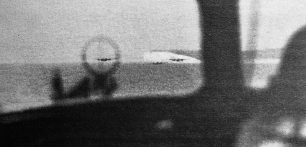
The Dorniers of the 9th Staffel approaching Beachy Head.

Rolf Von Pebal , Bundesarchiv

632AF27A-5F91-40EE-8951-F4BAD96CF485-306x132.jpeg


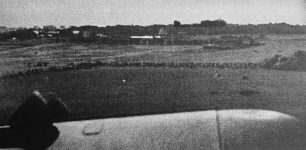
Passing Beachy Head, very low over the Channel.

Rolf Von Pebal, Bundesarchiv

26316E2F-775C-477A-8230-2356884E66D6-306x150.jpeg


Unteroffizier Guenther Unger's Dornier can be seen level with the horizon in this photo taken soon after crossing the coast with Seaford in the background.

Rolf Von Pebal, Bundesarchiv

50BC43A8-2172-4635-AAE4-006A1A457191-306x203.jpeg


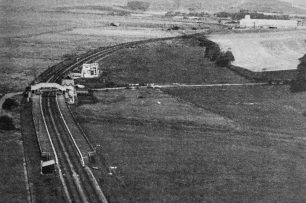
The railway halt at Southease, near Lewes.

Rolf Von Pebal, Bundesarchiv

7FE78651-E2DC-4CBE-A724-3D824BC1B314-306x189.jpeg


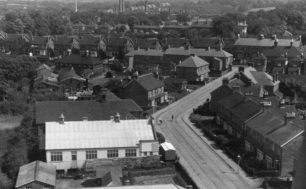
Cyprus Rd, Burgess Hill at 1.09pm. People run for cover as the low-flying Dorniers streak overhead.

Rolf Von Pebal, Bundesarchiv

24541D62-4914-416E-BA6B-8D5D652F40DF-306x222.jpeg


Hedge-hopping over Balcombe - the Balcombe to Hayward's Heath Rd running left to right across the photo.

Rolf Von Pebal, Bundesarchiv

0461E43B-4721-4592-B058-D5AD76EE2246-306x219.jpeg


One of Kenley's blast pens with a 64 Squadron Spitfire. The dust clouds in the background was pribably caused by the gunner in Unger's Dornier.

Rolf Von Pebal, Bundesarchiv

EA1D747B-6F78-4A46-8638-4D4741BB43A0-306x153.jpeg


Von Pebal's photograph was retouched to look more dramatic when it appeared in 'Der Adler' - the German propaganda magazine.

Rolf Von Pebal, Der Adler

On 18th August, 1940, the 4th War Reporter Detachment of the Luftwaffe despatched eight reporters and cameramen to fly with the two Bomber Geschwaders detailed to destroy the RAF’s Fighter Command airfields in the south-east.Two were to fly with the 9th Staffel for their low-level raid on RAF Kenley: war reporter Georg Hinze and photographer Rolf Von Pebal.
This is Rolf Von Pebal’s personal account and photographs of the raid, taken from the Dornier Do.17 flown by Feldwebel Reichel, 9th Staffel/KG76.

www.kenleyrevival.org

On the early morning of 18 August 1940 we drove to the airfield in preparation for a low-level mission against England. Gradually our friends and comrades arrived. There is great tension. After a departure delay of one hour we took off. Oddly, each of us has the uncertain feeling that today not everything will go smoothly.

At 13:20 we took off, all nine aircraft of the 9th squadron.

The tactic is as follows: The Ju88s of the 2nd group will lead with a dive-bombing attack, then the Do’s (Dorniers) of the 8th Staffel will drop their bombs. We are to conduct a low-level attack against the target.

The entire operation is to take place under a strong fighter escort. We cross the coast and descend low over the Channel and keep watch for fighters. Haze lies over the water, droplets stream from the cockpit windows.

Soon the quiet will end. We see the coast shimmering through the fog, ascend a few meters higher and then the English coast becomes clearly visible and very close. I photograph what I can. 600 meters to the left are two early warning boats which we leave alone.

They signal us and when we don’t reply we assume they are sending a radio report notifying their flak batteries of uninvited guests. We are already over steep cliffs. Now it can begin.

We are buzzing along at 300 kilometres per hour at an altitude of five meters over English countryside. Every terrain elevation provides us with cover, every forest is used as concealment. We leap over trees, it is a continuous movement up and down movement. I see no flak emplacements.

An express train passes under us and is gone, a pair riding bicycles takes cover in a ditch as if they were in basic training. Over parking areas, mansions, and castles, over factories and soot-darkened workers’ houses we race past.

Those that see the Balkan Cross on our wings are gripped by panic. Slowly we lose our section leader, the formation is disintegrating. There…..an airfield.

The last fighter has lifted off the ground and now the English are flying a wide curve to come up behind us… …as our bombs land and explode. A Spitfire hangs on the aircraft to our right and will not be shaken off. I watch as the tracers are exchanged between the two aircraft. Our radioman fires. A fighter closes from behind – my photography long forgotten.

The fighter grows larger while the radioman exchanges one ammunition drum after another. I see the flashes of light from the Englishman’s wing.

They are his cannons and machine guns. In our aircraft the noise is powerful. My foot receives an insane blow. I am convinced that I have been hit. I discover a hole in my boot and continue shooting.

There, he is hit. A lucky shot took care of the fighter and suddenly he crashes into a wood. Already he has disappeared from our eyes.

I watch as our radioman gasps, puts on a steel helmet with shaking hands and fits another ammunition drum on the machine gun. Suddenly a loud noise drowns out the sound of the engines and shatters the canopy. Immediately I think of a flak hit.

As I look to the rear I see a leafless and half torn tree disappear from view in a hollow. In the middle of England we have scraped a tree. Beneath us are houses, a collection of mansions before London. Two more times we must defend against fighters.

We have long since departed on the way home. We notice, that something is wrong with the aircraft. Often the observer up front shoots at flak positions. Several seconds later we are past. Now the radio operator fires to the rear as the target quickly passes by.

Finally, we are at the coast. The fighters are gone and we see nothing of our comrades. Barely are we over water when the left engine begins to fail and then stops.

The oil tank has been hit and its contents have run out. We sweat blood. Slowly the aircraft drags itself onward. With one engine it pulls to the side.

One looks at the others’ eyes to read their thoughts. The steel helmet bites into our necks, the hair clings to our foreheads, our blood races, the sweat is running in streams over our faces and dripping from our chins.

We still have not crossed halfway over the Channel. Anything, as long as it doesn’t mean ditching in the pond. None of us have the desire or strength to paddle now.

The coast is 30 minutes away. Will we make it 20 minutes with one engine? We try to start the second engine but the cylinders are frozen. The remaining engine pulls horrendously to one side.

The pilot must use his entire weight to offset the drag. We are prepared to use the rubber boat. It is clear to everyone that the likelihood of escaping the aircraft before it sinks is more than slim.

Everyone is stressed. The aircraft climbs a little, slowly, then drops again. Thankfully the coast is near. We crab to one side, the tail drops and we gain a bit of altitude.

There is high ground to our front. Our pilot decides to try flying over it. We barely make it and then are over a plateau.

Near Abbeville our Feldwebel pilot experiences an arm cramp. A place for an emergency landing is sought. We think we have found one. I put on the steel helmet, now a crash-helmet and press my head against the bulkhead and hold fast with legs and arms.

The landing gear is not lowered; only a belly landing can save us. The tension mounts, I hear the grain brushing against the aircraft, or is it only the wind rushing around the stopped engines?

A loud noise. I close my eyes. Is that all? Now a feeling of floating on the air, then a stupendous noise, a grinding and rending all around me.

I am gripped by a massive fist and pulled forward and down. In the same moment smoke is in the aircraft and a dust cloud makes breathing impossible.

For a moment all is quiet, then everyone moves to exit the aircraft. The escape hatch is stuck. If only the aircraft does not begin to burn.

Three of us press against the roof of the aircraft. With a loud roar the hatch gives way. Now we are outside, our small flight engineer has injured both knees, but the fantastic flight has finally ended.

For me this a fascinating insight into a Luftwaffe crew’s perspective on a raid during The Battle of Britain.

 
Churchill’s Address to Parliament . Tues 20th August 1940While the RAF was in action, Prime Minister Winston Churchill stood before Parliament to deliver one of his most famous speeches. Reflecting the nation’s admiration for Fighter Command’s daily sacrifice, he declared:

“Never in the field of human conflict was so much owed by so many to so few.”
This line—later immortalised in British memory—came to symbolise the Battle of Britain and the resolve of a nation facing overwhelming odds.

Among the pilots, the speech was met with pride and a sense of grim humour. As P/O Michael Constable-Maxwell quipped:

“He must be thinking of our liquor bills.”
 
favicon.ico
The RAF Chronicle
The-V1-Campaign-and-the-RAFs-Air-Defence-Response.jpg
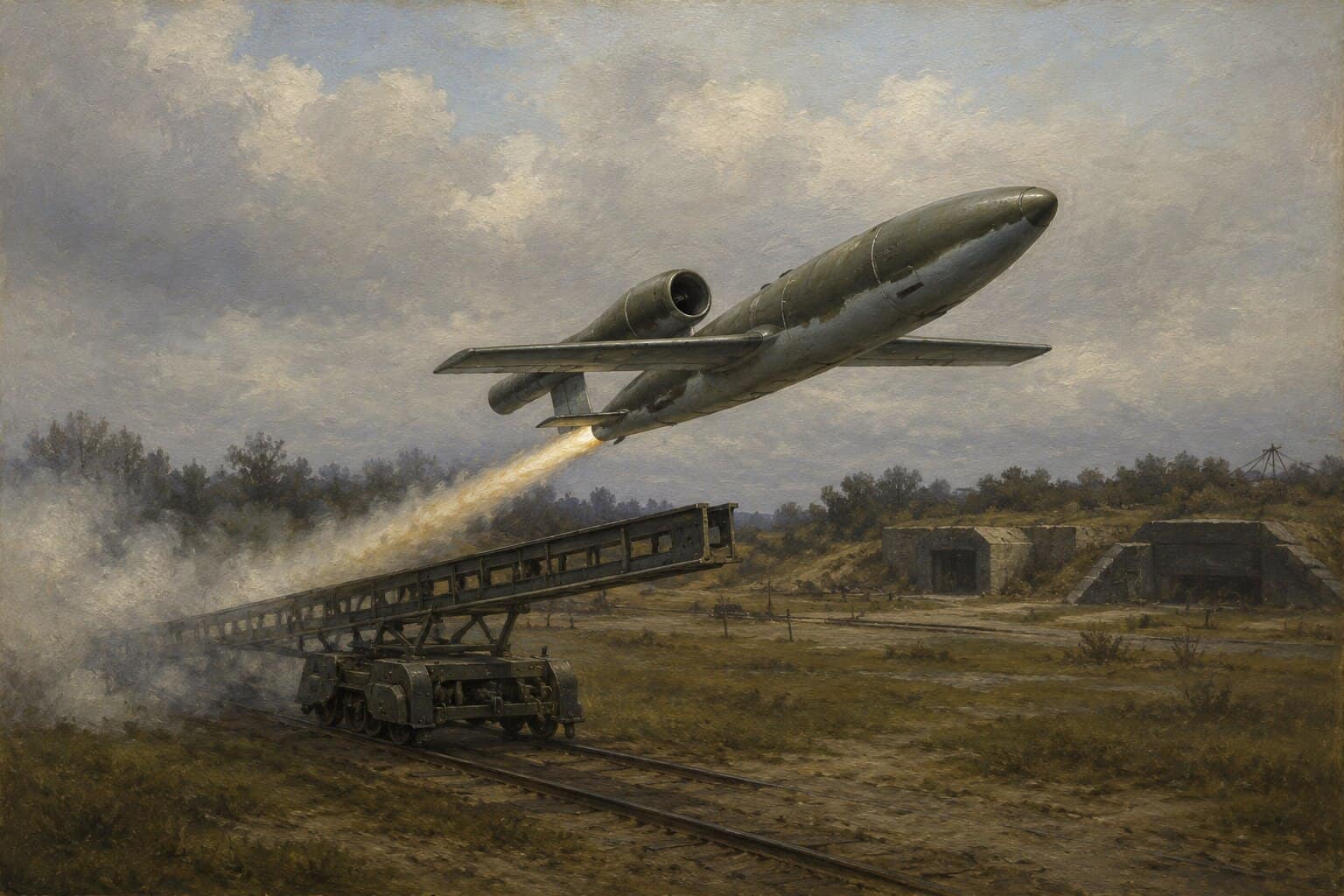
The V1 Campaign and the RAF’s Air Defence ResponseHow the RAF met the V1 offensive through Operation Diver, fighter interception and an adapted air-defence system over southern England.

Article23 June 20264 min read

The-V1-Campaign-and-the-RAFs-Air-Defence-Response.jpg


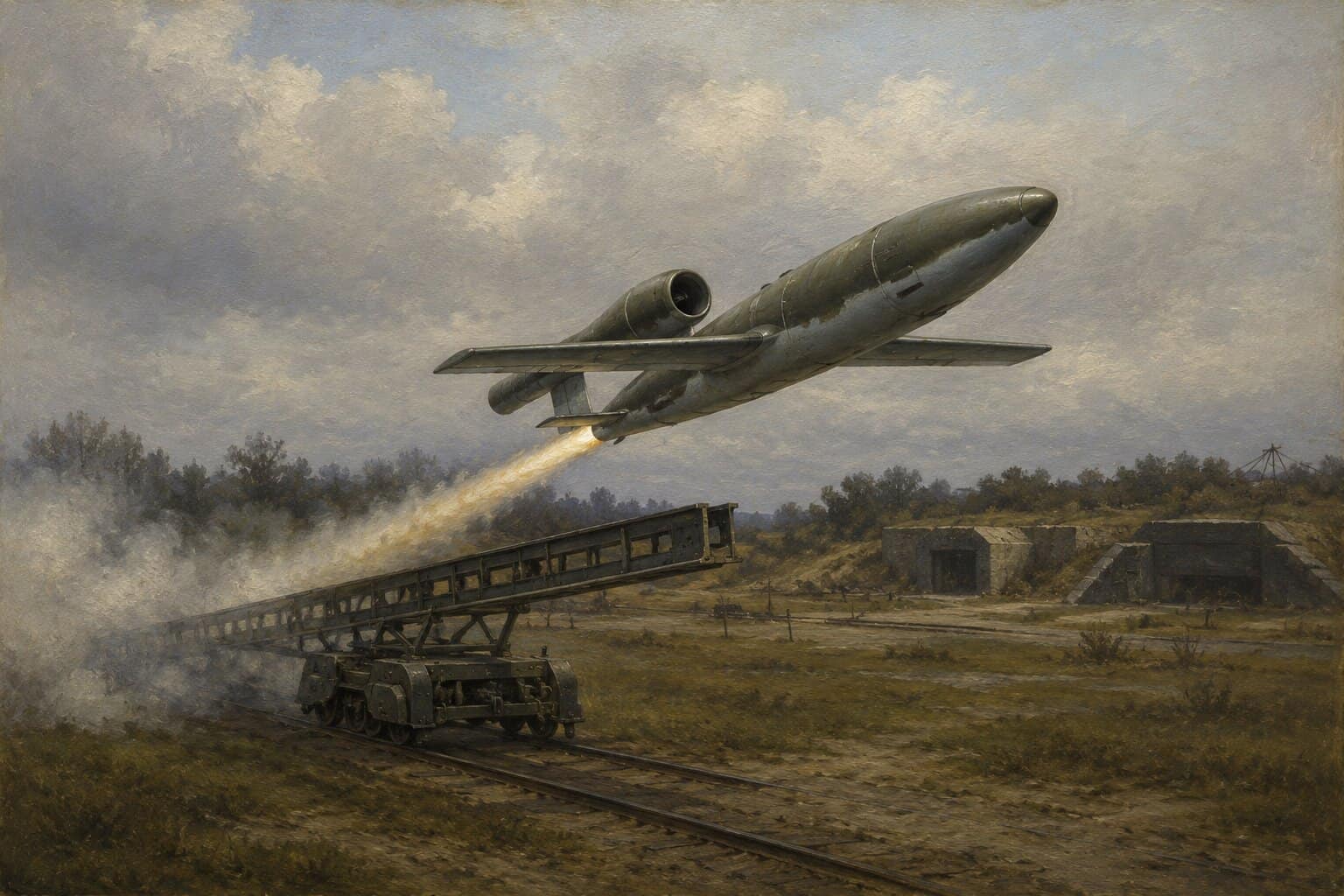
The V-1 campaign confronted the RAF with an attack that did not fit the familiar pattern of bomber operations. From June 1944, Germany launched pilotless flying bombs against London and southern England, forcing Britain’s air-defence system to respond to a fast, low-flying weapon that offered only a short interception window. For Fighter Command, the problem was not simply one of aircraft performance. It required a rapid adjustment in radar reporting, control methods, standing patrols and the distribution of fighter strength under what became Operation Diver.

The campaign belonged to a wider phase of the air war in which the RAF was already heavily committed to the invasion of north-west Europe, the strategic bombing offensive and the continuing defence of the United Kingdom. The V-1 threat imposed a demanding additional task. It required aircraft such as the Hawker Tempest, Supermarine Spitfire and de Havilland Mosquito to be used in a tightly organised defensive system that had to be adapted while the offensive was already underway.

BackgroundThe V-1 was designed as a bombardment weapon rather than a conventional aircraft. Its speed and low operating height made it a difficult target for both guns and fighters, especially during the initial attacks. The early phase of the campaign revealed that a system built to meet manned raids had to be adjusted for a pilotless weapon arriving on a narrower, more predictable track but at a challenging speed.

For the RAF, the answer lay in combining aircraft performance with control and geography. Fighter Command had already shown in earlier campaigns that warning, reporting and command organisation could matter as much as the qualities of the interceptor itself. During the V-1 offensive, that principle remained true. The defence had to be organised so that fighters were in the right place at the right height and could attack before the flying bomb reached the heavily populated areas around London.

Interception And AdaptationOperation Diver brought together Fighter Command, radar reporting, ground control and the wider British air-defence network in a concentrated emergency response. Patrol lines were adjusted, interception zones were pushed towards the coast where possible, and units were re-tasked to meet the threat more effectively. Aircraft that combined high speed with strong low-level handling became particularly valuable. The Hawker Tempest became especially associated with anti-diver work, while Spitfire variants and Mosquito night fighters also contributed materially to the defence.

The practical work of interception demanded accuracy and discipline. Pilots had to sight a small target, overtake it at high speed, open fire without losing control and destroy it in a way that did not simply move the danger onto the ground below. Most victories came through gunfire, though some pilots also used the hazardous expedient of upsetting a flying bomb with their wingtip when circumstances allowed. Whatever the method, success depended on rapid control, sound positioning and repeated sorties under intense operational pressure.

The campaign also demonstrated how quickly the RAF could alter existing doctrine. Fighter Command had not been created to meet pilotless cruise weapons, yet it adapted its command methods, aircraft employment, and patrol system to do so. That flexibility was as important as any single aircraft type. Without control and concentration, speed alone would not have been enough.

Results And LimitsAs the defence improved, a greater proportion of V-1s were intercepted before they reached their intended urban targets. Even so, the weapon could not be dismissed as a minor nuisance. Many flying bombs still struck built-up areas, causing civilian casualties, destruction and sustained public anxiety. The campaign became a test not only of tactical efficiency but of endurance within Britain’s home front and air-defence machinery.

The burden on RAF units was considerable. Anti-diver patrols imposed a repetitive and demanding form of flying, often at awkward heights and in poor conditions, and they had to be maintained alongside wider wartime commitments. The threat also evolved as launch arrangements changed and the geographical problem shifted. This prevented the defence from becoming a settled routine and necessitated further adjustments to deployment and control.

Wider SignificanceThe RAF’s response to the V-1 offensive showed that Britain’s air defence in the later war remained an integrated system rather than a static inheritance from 1940. The same institutional strengths that had mattered in the Battle of Britain — warning, control, disciplined interception and organisational flexibility — were applied to a different technological problem. In that sense, the campaign formed part of the longer wartime history of Fighter Command, not merely an isolated episode at the end of the war.

It also revealed a broader truth about air power. New weapons did not remove the need for command systems; they increased it. The V-1 was a reminder that technological novelty could force rapid changes in doctrine, basing and operational method. For the RAF, the defence against the flying bomb was therefore both an immediate operational necessity and an early encounter with the challenges posed by guided weapons. Its importance lay not only in the number of interceptions achieved, but in the speed with which the Service adapted its existing air-defence system to meet a new form of attack.

 
https://www.cradleofaviation.org/history/history/women-in-aviation/harriet_quimby.html

6938f5c4-37e4-420e-9909-84a7f485077c.jpg


HARRIET QUIMBYAlthough most aviation buffs know that Quimby was the first American woman to earn a pilot's license and the first woman to make a solo flight across the English Channel, little else is known about her or her short career as an aviator. Perhaps her life remains a mystery because she publicly flew for less than a year and she intentionally created an aura of intrigue about her early life.

"In my opinion, there is no reason why the aeroplane should not open up a fruitful occupation for women."

– Harriet Quimby, 1912

Facts:
  • Born May, 1875 to a poor farm family in Michigan
  • Became a reporter, photographer and literary and theatrical writer for Leslie’s Magazine, 1903-1912 while living in New York.
  • Attended the Belmont Park Air Meet in October 1910 where she became enthralled with aviation and determined to learn to fly.
  • Learned to fly at the Moisant Aviation School in Mineola on a French Bleriot Monoplane.
  • Took her licensing test on August 1, 1911 and passed, thus making her the first licensed female pilot in the United States.
  • Participated in several air shows in the Fall of 1911 and became the first person to fly over Mexico City. -Flew at the Nassau Boulevard, Long Island, Air Meet in September 1911, and won the cross-country race.
  • Became the first woman to fly the English Channel on April 15, 1912, but her feat went largely unnoticed as the Titanic sank the same day.
  • She was considered a radical woman in her day because she smoked, owned a car, flew an airplane, traveled the world extensively – alone as well as being a professional writer and photographer.
  • She was known as a "green-eyed beauty" in a plum-colored satin flying suit which she designed herself. This outfit, then considered risqué, soon became a fashion trend and she was often called the "Dresden Doll Aviatrix" by fans because of her dashing, yet feminine image.
  • Killed on July 1, 1912, at the Harvard-Boston Air Meet when she was thrown from her plane.
  • She always wanted a "fadeless immortality" and received it due to her distinct and determined personality and her many accomplishments in her short life.
More about Harriet Quimby(Courtesy of the FAA)

Born in Coldwater, Michigan, in 1875, Quimby led people to believe she was born in Arroya Grande, California, in 1874. Although she did grow up in Arroya Grande in a poor rural family, many presumed her to be from a wealthy family and well-educated in the United States and France. Beautiful and well-poised, Quimby aptly carried out the charade. Encouraged by her mother to believe that she could succeed in almost any endeavor, she relied on her talents and wit to accomplish what few women of her time even dared to dream about. An anomaly for her time, Quimby willingly disregarded societal convention, opting for a career rather than marriage.

Harriet Quimby's public life began in 1902, when she began writing for the San Francisco Dramatic Review and also contributed to the Sunday editions of the San Francisco Chronicle and San Francisco Call. Pursuing a career in a field few women entered at that time, she stood out among her peers for a variety of reasons. For example, according to one biographer, while working in California, she was one of the first journalists anywhere to use a typewriter. She also often could be seen driving her yellow car around town, a unique sight since automobiles were still a rarity at the turn of the century. In 1903, she moved to New York where she joined the staff of Leslie's Illustrated Weekly as a drama critic and editor of the women's page. Unwilling to remain content with these tasks, the ambitious Quimby soon began writing feature articles for the magazine.

The young journalist's love of aviation was born in October 1910, when she attended an international aviation meet at Belmont Park, New York. She quickly became intrigued by both the airplanes and by John Moisant, the pilot who successfully won the race, beating his competition in the course around the Statue of Liberty. Quimby asked Moisant to teach her to fly. However, before she could begin lessons at the Moisant Aviation School on Long Island, John Moisant died when his plane crashed at an air meet in New Orleans. Undaunted, Quimby began lessons with John's brother Alfred. While at the school, she met and quickly befriended fellow student and Moisant sister, Matilde.

Quimby quickly discovered a passion for flying, and on August 2, 1911, after four months and thirty-three lessons, she applied for and won her pilot's license by performing two test flights. This made her the first American woman and the second female ever to receive a pilot's license from the Federation Aeronautique Internationale in France, which had begun offering licenses through the Aero Club of America. Matilde Moisant becomes the second American woman to earn such a license.

With license in hand, the "Dresden China Aviatrix" or "China Doll," as the press dubbed her because of her petite stature and fair skin, moved to capitalize on her new notoriety. Americans loved flying, and pilots could earn as much as $1,000 per performance, and prize money for a race could go as high as $10,000 or more. Quimby joined the Moisant International Aviators, an exhibition team, and made her professional debut, earning $1,500, in a night flight over Staten Island before a crowd of almost 20,000 spectators. As one of the country's few female pilots, she capitalized on her femininity by wearing trousers tucked into high lace boots accentuated by a plum-colored satin blouse, necklace, and antique bracelet. She drew crowds whenever she competed in cross-country meets and races. As part of the exhibition team, she showcased her talents around the United States and even went to Mexico City at the end of 1911 to participate in aviation activities held in honor of the inauguration of President Francisco Madero.

While touring with the airshow, she continued writing for Leslie's and recounted her adventures in a series of articles. Her personal reports discussed topics such as how she learned to fly and earned her pilot's license, and on the dangers of flying. Totally committed to her new passion, the dedicated journalist and aviator avidly promoted the economic potential of commercial aviation and touted flying as an ideal sport for women. Hoping to earn a global reputation with its incumbent fame and fortune, Quimby decided to attempt a channel crossing from England to France in late 1911. The feat had been first accomplished by Louis Bleriot in 1909 and subsequently by other pilots, but never by a woman. In March 1912 she sailed for England to begin preparations for her daring flight. English pilot Gustav Hamel helped her plan the trip. In thickening fog on the morning of April 16, 1912, the adventuresome pilot began her flight from Dover to Calais in a Bleriot monoplane. As she later recounted, "in an instant, I was beyond the cliff and over the Channel." As visibility decreased in the dense fog, Quimby recalled, "I could not see ahead of me at all, nor could I see the water below . . . there was only one thing for me to do, and that was to keep my eyes fixed on my compass" – a compass Hamel had recently taught her how to use. Quimby successfully crossed the channel, landing at Hardelot, approximately 25 miles south of her original destination. Her hopes for front-page headlines never materialized, and her achievement went largely unnoticed in the next days' papers. Quimby's daring feat had been overshadowed in the press by the sinking of the Titanic two days earlier.

Despite the disappointment that worldwide fame had eluded her, Quimby loved to fly and continued competing in air meets. Unfortunately, her career was short-lived. On July 1, 1912, less than three months after her channel crossing, she made her tragic last flight. While performing at the Harvard-Boston aviation meet in her new 70-horsepower Bleriot monoplane, Quimby lost control of the aircraft. Both she and a passenger were thrown out of the plane, and, in front of horrified spectators, they plummeted to their death in the shallow waters of the Boston harbor.

Not until almost eighty years after her death did Harriet Quimby receive the kind of accolades she had hoped for after her channel crossing. On April 28, 1991, the United States Post Office issued a commemorative stamp honoring her contributions to aviation. The 50 cent airmail stamp features a picture of the aviator, dressed in her purple satin blouse, superimposed over her Bleriot monoplane. The stamp simply states "Harriet Quimby: Pioneer Pilot."

 
https://richardiii.net/george-duke-of-clarence-his-brother/

George, Duke of Clarence (Brother)by Wendy Johnson

George, Duke of Clarence is a controversial figure, often depicted as grasping, envious, even drunken. But how much of this lively portrayal is actually true? Historians are divided, and novelists have often felt free to create a monster whose character traits are every bit as colourful as those of the fictionalised Richard III. While there can be little doubt that the facts of George’s life reveal a troubled and unhappy individual, perhaps like his brother Richard, George may in time benefit from further re-assessment.

The third surviving son of Richard, Duke of York and Cecily Neville, George was born in Dublin on 21st October 1449, during his father’s Lieutenancy of Ireland. When he was eleven months old, George’s family returned to England and his early years witnessed the dawn of the political upheaval popularly known as the ‘Wars of the Roses’. When George was six, violence erupted between supporters of Henry VI (Lancastrians) and those of the Duke of York (Yorkists), and as a result the ensuing years witnessed periods of intermittent but bloody conflict. In 1459, the capture of George (10), and his young brother Richard (7) at the Lancastrian rout of Ludlow must have left a fearful impression upon both boys.

Following their father’s death at the Battle of Wakefield in December 1460, George and Richard were sent to the Low Countries for safety. However, exile lasted only a few months and both boys returned to England when their elder brother, Edward, defeated the Lancastrians at Towton in March 1461 and assumed the throne as Edward IV. In the wake of the Yorkist triumph it is possible that a marriage alliance was proposed between George and Mary, the young granddaugher of the Duke of Burgundy, although nothing substantial appears to have come of this.

On the eve of Edward’s coronation, George was invested as a Knight of the Bath. The king also honoured him with the Lieutenancy of Ireland and the dukedom of Clarence. Still a minor, the new duke remained in the company of his siblings, Margaret and Richard, in their own household at the palace of Placentia (Greenwich). Assuming his majority on 10th July 1466, George established his own household at Tutbury Castle, Staffordshire. There is no doubt that the grants received from King Edward at this time were particularly generous, and that George’s lifestyle was illustrative of his new status as heir presumptive. The adolescent George was finding his place in the world, undoubtedly conscious of his exalted position in the line of succession.

Things, however, were about to change. In 1464 Edward IV’s clandestine marriage to Elizabeth Woodville, widow of the Lancastrian knight, Sir John Grey, created deep divisions within the House of York. Particularly angered was Edward’s most powerful supporter and cousin, Richard Neville Earl of Warwick, whose foreign diplomacy aimed at a dynastic union with a continental princess. A mutual bond of resentment formed between Warwick and George of Clarence; united in their dislike of the new queen and her siblings’ monopolisation of the aristocratic marriage market.

But soon another marriage was mooted on George’s behalf, this time with Warwick’s eldest daughter, Isabel Neville. Edward refused to countenance the match, perhaps anticipating a dangerous alliance between his brother and their powerful cousin. Undaunted, George and Warwick conducted secret negotiations with the papal authorities and a dispensation was duly granted. Stealing across the Channel, George and Isabel were married at Calais in July 1469, by Warwick’s brother the Archbishop of York. Upon their return to England, Warwick and George issued a manifesto condemning the growing political influence of the queen’s family and repudiating the Woodvilles’ ‘disceyvabile covetous rule’. Rebellion soon ensued, with Warwick and his new son-in-law, George, openly opposing Edward. Imprisoning the king in the Yorkshire castle of Middleham, Warwick gave orders for the execution of the queen’s father, Richard Woodville, and her brother John. In addition, Elizabeth’s mother, Jacquetta, was accused of dabbling in the black arts. However, despite Warwick’s popularity in the capital, lawlessness was soon evident and it became apparent that the kingdom could not fully function without the discernible presence of the king. Edward was therefore allowed to ‘escape’ and a reconciliation of sorts took place.

Although George had remained aligned with Warwick, his father-in-law’s mounting dissatisfaction took a new and dangerous turn as the earl defected to the Lancastrians. George’s personal feelings, as Warwick threw in his lot with their old enemies, can only be guessed at. Under the terms of the new alliance, Warwick would help re-establish the old Lancastrian regime by restoring Henry VI to the throne. As a reward, his younger daughter, Anne Neville, would marry the Lancastrian Prince of Wales. Whilst this arrangement might have seemed advantageous to Warwick, George’s position became increasingly precarious. The best he could hope for was to remain heir presumptive, should Edward of Lancaster and Anne fail to produce heirs of their own,

King Edward was forced to flee to the Continent, along with his brother Richard and a number of close retainers.

Meanwhile, the family of York was eager to draw George back into the fold. His sisters penned letters of encouragement while Edward, having successfully raised support in the Low Countries, employed a go-between to sound out his brother’s intentions. Increasingly discontented with Warwick’s policies, George agreed to return to his old allegiance and act as a mediator between Edward and the earl. So far so good. But when Warwick refused to capitulate, George took to the field alongside his brothers, and on Easter Sunday 1471 the earl was slain at the Battle of Barnet. The Battle of Tewkesbury, less than three weeks later, saw the death of Edward of Lancaster and the re-establishment of Edward IV on the throne of England.

Sadly, victory did not put an end to family conflict. As Edward’s second reign commenced, George and his brother, Richard, were at odds over the fate of the newly widowed Anne Neville. In the aftermath of Tewkesbury, George and Isabel had taken Anne into their care. Anne, as Isabel’s sister, was co-heir of the Warwick inheritance and, as Richard wished to make her his wife, her share of the inheritance was of concern to George. Opposing the match, George concealed Anne in order to thwart his brother’s matrimonial plans. Richard, however, discovering Anne’s whereabouts, transferred her to the sanctuary of St Martin-le-Grand. Richard and Anne were duly married and Edward eventually imposed a settlement, dividing the inheritance in two acts of parliament. Finally, George and Richard came to terms.

For a time dealings between George and the king appeared reasonably stable, although a question mark remained over his relationship with the queen. George, by association, was implicated in the execution of Elizabeth’s father and brother in the wake of Warwick’s rebellion. Following the death of Isabel Neville in December 1476, and the subsequent demise of their new born son, George immediately suspected foul play. In April 1477, he abducted one of Isabel’s former attendants, Ankarette Twynho, trying and executing her on the charge of poisoning her mistress. A further servant, John Thursby, was accused of administering poison to the infant.

Relations between George and his brother, the king, now swiftly deteriorated. Following Isabel’s death, the prospect of marriage between George and Mary of Burgundy re-emerged, but Edward refused to countenance the match. A subsequent proposition – marriage to a Scottish princess – met with an equally negative response.

In May 1477, a member of George’s household, Thomas Burdett, was charged with ‘imagining the king’s death by necromancy’. In addition, he was accused of writing verses predicting the downfall of Edward’s direct heirs. When Burdett and an associate, John Stacy, were executed at Tyburn on charges of high treason, George stormed unannounced into a meeting of the royal council at Westminster Palace, ordering Burdett’s declaration of innocence, uttered from the scaffold, to be read aloud. As a result of his actions, George was arrested on the orders of the king for matters ‘in contempt of the law of the land.’

George’s fate was sealed. In January 1478, Edward himself brought a charge of high treason against his brother, of plotting against himself, Queen Elizabeth and their offspring. In addition, George stood accused of sowing sedition amongst the king’s subjects, and of inciting rebellion with the intent of seizing the throne. Edward was at great pains to recount how, despite the mercy he had previously shown his brother, George had continued to involve himself in treasonous activity. Inevitably George was condemned, an Act of Attainder was passed, and his lands made forfeit. The duke himself was consigned to the Tower pending execution. George died on 18th February 1478, allegedly by immersion in a vat of Malmsey wine, and was buried alongside his wife in Tewkesbury Abbey.

To this day, George of Clarence remains a fascinating and enigmatic figure. However mercurial his loyalties to his king, there can be little doubt of his commitment to his wife and children. His genuine belief that, towards the end of his short life, he and his family were in imminent danger is evidenced by an attempt to convey overseas his remaining son, Edward of Warwick. The indictments presented by Edward IV against his brother are clearly recorded and make damning reading, yet the claims made by George against the king are equally astounding. Edward, George declared, was not only guilty of employing the black arts ‘to poison his Subgettes, suche as hym pleased’, he was also illegitimate, with the result that neither he, nor his children, were eligible to rule. Most chilling of all, George’s assertion that the king ‘entended to consume hym  in like wyse as a Candell consumeth in brennying (burning), whereof he wolde in brief tyme quyte hym.’ None can doubt that in his final accusation, at least, George was telling the truth, Moreover, George’s request to ‘uphold his case by personal combat’ (Crowland Chronicle) illustrates a profound belief in the veracity of his cause.

Those hostile to Richard III have suggested that as a royal duke, and brother to both George of Clarence and the king, Richard could have interceded on George’s behalf, or at least voiced some objection to his brother’s trial and execution. However, five centuries later, we cannot say with any degree of certainty that he did not. Any private conversations between Richard and the king are likely to have been unrecorded, particularly if Edward would not be moved on the matter. On the other hand, it is unclear how any intervention on Richard’s part could have succeeded. Action to undermine a charge of treason would ultimately have called into question the judgement of the king himself. Open, as opposed to private, support for George would also have allied Richard with a convicted traitor. George’s fate alone makes it clear that nearness of blood did not, in itself, prevent Edward arraigning a brother for such an offence. All that can be said is that a convicted traitor invariably suffered a public death by means of hanging, drawing and quartering. If George did meet his fate in a butt of Malmsey wine, then this commuted sentence came at the behest of someone close to him.

In recent years the late historian John Ashdown-Hill has emphasised the contemporary belief that the power behind the conviction and death of George of Clarence was Edward’s queen, Elizabeth Woodville. In a letter written to the Earl of Desmond in 1483, the newly crowned Richard III appears to confirm his own belief concerning the involvement of others, besides Edward IV, in his brother’s death and subsequent execution.

 
image.png

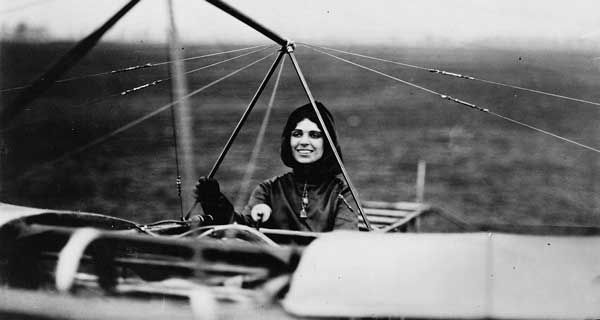
Harriet Quimby in 1911.

On 16th April 1912, Harriet Quimby took off from Dover, en route to Calais,. She completing the historic flight in 59 minutes after landing about 25 miles (40 km) from Calais on a beach in Equihen-Place, in the Pas -de Calais.

She was the first woman to pilot an aircraft across the English Channel.

Her ‘instrumentation’ consisted of a watch and a hand-held compass, and pilot comfort entirely in the hot water bottle she had strapped to her middle.

Her accomplishment received little media attention however as it occurred the day after news broke of the sinking of the Titanic on 15th April. To make her flight across the English Channel, she had purchased a Bleriot 50 Monoplane.

Quimby-Harriet_23.jpg


A group of men, including Harriet Quimby's flight instructor (right), examine her downed monoplane following her tragic accident. The plane had flipped over onto its back after landing in Dorchester Bay.

 
image.png

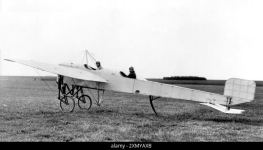
A Bleriot 50 Monoplane.

image.png

Louis Blériot at the helm of his monoplane, furnished with automatic motor of 50 horsepower.

Hence the name. Bleriot 50 Monoplane.

 
image.png

A biplane flying over Salisbury Plain, with three Army staff officers on horseback in the foreground.

The British Army formed its first Air Battalion in 1911, which evolved into the Royal Flying Corps in 1912.

Then into the R.A.F in April 1918.

This was the past, present and future of the military.

Although the army and navy only wanted aircraft to be used for reconnaissance and ‘gun spotting’!

 
image.png

An observation balloon of the Royal Flying Corps during World War One.

A very dangerous job!

image.png

RE8 observation biplanes of the Royal Flying Corps beside a road in northern France. March 1918.

Aircraft and air warfare,developed dramatically and very rapidly during World War One.

 
The City of Tyre is today joined to the land and part of modern day Lebanon.

In 332 BC it was an island 800m away from the mainland it refused to give Alexander the Macedonian leader entry..

This led to a 7th month siege and the building of a causeway which today has become a connecting landmass with modern housing built on the causeway.

It had defied all-comers from a 1000 year period and was now gong to outlast Alexander or so they thought.

This shows the island in antiquity

330px-Siege_tryre.gif


This clip takes you into the detail of the siege and is very interesting.

https://www.youtube.com/watch?v=xO61rVGE5hU

 
The Takedown of Tyre IPublished July 2021 www.warhistory.org


Tyre, in what is now Lebanon, was the holdout. It had a unique place as the largest and most important Phoenician port in the eastern Mediterranean, and as an important Persian naval base.

Tyre had been a prominent city for centuries by the time that Alexander arrived.

The Phoenician merchants from Tyre had been among the first people to send their trading ships throughout the Mediterranean. The city grew rich and powerful and was coveted by its neighbors.

King Nebuchadnezzar II, known as “the Great,” who built the Hanging Gardens of Babylon, had unsuccessfully besieged the city for 13 years in the sixth century BC.

Eventually, the Tyrians threw in their lot with the Persians.

To secure their metropolis, the Tyrians built a new city on an island a half mile offshore from the old city on the mainland.

This new Tyre was now an impregnable fortress surrounded by two miles of stone walls that were reportedly as high as 150 feet.

The island had two ship harbors, the northern one named for Sidon, the southern one named for Egypt. Through these harbors, Tyre could be supplied from the sea, regardless of who controlled the adjacent mainland.

Alexander had hoped to avoid the necessity of a siege entirely. He was optimistic when his  armywas met on the coast road by ambassadors from Tyre, who told him, according to Arrian, that the city “had decided to do whatever he might command.”

Alexander said he would like to enter their city and offer a sacrifice to Heracles—known to the Tyrians as Melqart—at the temple that had been erected to him in the southern part of their island citystate.

He explained that he was descended from Heracles, as were all of the kings of Macedonia.

Their response was not what he expected. The Tyrians, then ruled by King Azemilcus, told him he was welcome at another temple of Heracles located on the mainland, but he could not enter the island.

With this, the die was cast. Tyre must be taken. Thus began an epic siege that took place over the spring and summer of 332.

In a speech possibly transcribed by Aristobulus or Callisthenes, and passed down by Arrian, Alexander told his officers of his strategic view of the eastern Mediterranean, explaining why Tyre was so important:

“I see that an expedition to Egypt will not be safe for us, so long as the Persians retain the sovereignty of the sea; nor is it a safe course, both for other reasons, and especially looking at the state of matters in Greece, for us to pursue Darius, leaving in our rear the city of Tyre itself in doubtful allegiance. . . . I am apprehensive lest while we advance with our forces toward Babylon and in pursuit of Darius, the Persians should again conquer the maritime districts, and transfer the  warinto Greece with a larger army.”

The conventional wisdom held that Tyre could be assaulted only from the sea, and its huge, solid walls would protect it from that.

Besieging Tyre presented a dilemma, given that the Tyrian fleet and the allied Persian fleet under Autophradates had naval superiority in the eastern Mediterranean, while Alexander had deliberately undercut his own navy.

According to folklore, readily retold by Arrian as fact, the solution came to Alexander in a dream. He dreamed that Heracles took him by the right hand and led him up into the city, walking on dry land.

Though the dream needed little in the way of interpretation, it was declared to be a good sign by Aristander, the seer who had once told Philip II that his son within the womb of Olympias would be as bold as a lion.

Alexander had relied on his prognostications more than ever after he correctly predicted the victory at Granicus.

If Tyre was separated from dry land by a half mile of water, he would just take the dry land to the city.

Alexander decided to solve the problem at hand by turning Tyre from an island into the tip of a peninsula by building a causeway to it from the mainland.

The portion of the channel closest to the shore was a gently sloping tidal plain. There was an abundance of rock and other construction material nearby, so getting started on this project would be relatively easy.

Closer to the island fortress city, however, the channel was 18 feet deep, so it would be more challenging.

A difficult task under any circumstances, building a causeway here beneath hostile walls was a serious problem for work crews with Tyrian archers raining projectiles down upon them.

However, morale inside the walls was shaky as well. The Tyrians too, had a dream. They dreamed that Apollo told them he was, as Plutarch paraphrases it, “going away to Alexander, since he was displeased at what was going on in the city.”

The project began with wooden pilings being driven into the mud with a roadway constructed on top. The work proceeded rapidly at first, but as the Macedonians got into the channel, the crews came under fire from Tyrian warships.

To stave off this harassment, Alexander had two tall siege towers constructed at the end of the causeway from which his troops could return fire against the ships.

Their elevated position meant that the men in the towers could see farther, and their projectiles had greater range, than they would from near sea level.

The Tyrians struck back using a transport barge as an incendiary device. They piled it high with wood scraps and other flammable material, including pitch and brimstone.

To its masts they fitted long double yardarms, attaching caldrons containing additional flammable material. They towed the barge near the causeway towers using triremes, setting it on fire as it neared the towers at the end of the causeway. The yardarms were long enough to cantilever over the causeway and strike the towers, which were soon engulfed in flames.

Attempts by Alexander’s personnel to fight the fires were met by archers aboard the triremes. The Tyrians also landed troops on the causeway who burned catapults and other equipment before withdrawing.

After a stroke of engineering brilliance in his causeway idea, Alexander had been halted rather ignominiously.

However, it was merely round one.

Alexander promptly ordered the causeway to be widened and new towers to be built. Meanwhile, he decided to acquire additional warships of his own, having realized that defeating Tyre would require sea power after all.

 
The Takedown of Tyre IIPublished July 2021 www.warhistory.org


Expanding his  navy was actually easier for Alexander than might have been expected. Because most of his recent conquests and alliances had involved maritime powers, his new friends were willing to contribute to his fleet-building efforts.

According to Arrian, Cyprus sent 120 warships to Alexander, while both Sidon and Rhodes contributed some triremes, and “about 80 Phoenician ships joined him.”

Both Gerostratus and Enylus, the kings respectively of Aradus and Byblos, “ascertaining that their cities were in the possession of Alexander, deserted Autophradates and the fleet under his command, and came to Alexander with their  naval force.”

Alexander also personally joined the naval attack on Tyre, sailing with the fleet as it embarked from Sidon. His own position was at the right wing of the armada, farthest from the coast.

His initial strategy had been to lure the Tyrians into a battle in the open sea.

The Tyrians had been looking forward to such a fight on the basis of Alexander’s perceived naval inferiority, but when they observed Alexander’s fleet most remained in port rather than accepting the challenge.

Alexander’s flotilla managed to sink three vessels, but aside from that they were at a stalemate.

Alexander for once had the superior numbers in a naval battle, but he could not lure out his enemy.

If a fight took place, it would have to be in the tight confines of one of the island’s two harbors.

It was like Issus, only on water—and at Issus, it was Darius who was in too tight a space to make full use of his superior numbers.

Alexander decided to blockade Tyre and wait. He assigned the Cypriot triremes to block the northern Tyrian port and dispatched the Phoenician fleet to block the southern port.

He then turned back to his land strategy, ordering the rapid construction of catapults and siege engines, including battering rams and protected towers for the transfer of troops.

These were placed on ships for the final assault against Tyre’s fortifications.

The Tyrians countered by building towers of their own in order to be higher than the Greco- Macedonian besiegers. It became a battle of fiery projectiles launched from higher and higher elevations.

Eventually feeling the pressure of the naval blockade, the Tyrians made an attempt to break out of the northern port using a force of seven triremes, three quadriremes and three quinqueremes.

The ships moved silently so as not to alert the Cypriot blockade ships, but it would not have been necessary.

The Cypriots were asleep at the tiller. Indeed, each ship was manned by a mere skeleton crew, with most hands having been quartered ashore.

Catching the Cypriot fleet off guard, the Tyrians managed to sink or damage a number of vessels.

Roused from his tent—all of this happened in the heat of the summer afternoon as the officers were resting.

Alexander ordered all available ships in the port on the mainland side of the channel to put to sea to prevent any additional Tyrian ships from reaching open seas.

Alexander boarded a ship himself, intending as usual to lead from the front.

Despite calls from Tyrian lookouts that Alexander’s ships were pulling out from their moorings, ships continued to leave the port.

Alexander’s fleet rallied, ramming and sinking a number of vessels, and capturing others.


Assault on TyreFinally, Alexander developed a tactical plan that called for a complex amphibious landing under fire that would be considered ambitious even by a modern combat force.

In the northern part of the island, where the causeway had been built, Tyre’s walls were the most formidable and best defended, so Alexander moved to execute an unanticipated flanking maneuver by hitting a less well defended point in the southern end.

The attack would entail breaching the wall above sea level from the sea using siege engines aboard ships, and then using a portable bridge to push troops through this breach. Indeed

, attacking a vertical wall above sea level is always much more difficult than putting troops across a sea-level beach using landing craft.

With Tyrian defenses pierced, Alexander’s fleet would attack the two Tyrian ports simultaneously.

When his first attempt to execute the plan was quickly repulsed, Alexander withdrew, postponing a renewed attempt until a patch of stormy weather had blown through.

On the third day following, the seas were quieter and Alexander resumed the assault.

After seven months, the siege finally reached its climax on the last day of the month of Hekatombaion, the same month that Alexander celebrated his twenty-fourth birthday (July 20, 332 BC).

Plutarch tells that after consulting some omens, Aristander had declared confidently “that the city would certainly be captured during that month.”

Because it was the last day of the month, and Tyre had held out for 200 days already, Aristander’s words “produced laughter and jesting.”

Arrian says that Alexander “led the ships containing the  military engines up to the city.

In the first place he shook down a large piece of the wall; and when the breach appeared to be sufficiently wide, he ordered the vessels conveying the military engines to retire, and brought up two others, which carried the bridges, which he intended to throw upon the breach in the wall.

The shield bearing guards occupied one of these vessels, which he had put under the command of Admetus; and the other was occupied by the regiment of Coenus, called the foot Companions.”

When the siege engines pulled back, Alexander sent in triremes with archers and catapults to get as close as possible, even if it meant running aground, to support the infantry assault.

Again leading from the front, Alexander himself headed the assault force that went ashore. Admetus’s contingent was the first over the wall, but he was killed in action, struck by a spear.

Alexander then led the Companion infantry in securing a section of wall and several towers.

With Greco-Macedonian troops taking and holding a rapidly expanding beachhead, the defensive advantages of the fortified city began to evaporate.

Unfortunately for the Tyrians, their royal palace was in the southern part of the city, and it was one of the first major objectives to fall to Alexander’s invading troops.

King Azemilcus, his senior bureaucrats and a delegation of Carthaginian dignitaries, who had been trapped in Tyre when Alexander’s fleet sealed the ports, were there but escaped to take refuge in the temple to Heracles.

Ironically, this was the same temple at which Alexander had originally asked to be allowed to worship.

At the same time, Alexander’s fleet forced its way into the two harbors. Phoenician ships entered the southern harbor, the Port of Egypt, and the Cypriot ships breached the entrance to Tyre’s northern harbor, the Port of Sidon.

Here at the Port of Sidon, the larger of the two anchorages, troops were able to get ashore inside the harbor.

The defenders fell back to defensive positions at the Agenoreum, a temple to the mythical King Agenor, but were quickly routed. Alexander now had beachheads on either end of Tyre and the Tyrian defenders in a pincer.

Within a matter of hours, after a bloody siege of seven months, troops from both landings linked up in the northern part of the city. All of the defenses that had been erected on the causeway side were for naught.

According to Diodorus, immediately after his victory Alexander ordered the causeway broadened to an average width of nearly 200 feet and made permanent, using material from the damaged city walls as fill.

The causeway is still there, although it if you visited it, you would not notice it.

Over the past 2,300 years, wave action and drifting sand have caused it to grow into a broad isthmus about a quarter of a mile wide.

The part of Tyre that was an island in 332 BC has been connected to the mainland ever since Alexander’s day.

Alexander gave no quarter to those he captured, killing them on the spot or eventually selling them into slavery.

According to Arrian, the defenders suffered about 8,000 killed or executed and 30,000 made slaves, while the Greco-Macedonian force lost 400 killed in action during the entire siege.

Curtius reports 6,000 Tyrian troops killed inside the city walls, and 2,000 executed in the aftermath.

While these numbers were probably stretched in favor of Alexander, many later scholars, including Botsford and Robinson, repeat them. There is no way of knowing for sure.

In any case, Alexander walked into the Temple of Heracles around sundown that day to make his long-postponed sacrifice. It was the afternoon of the last day of Hekatombaion.

Of all those who had laughed at Aristander for his outlandish prediction, none were laughing now.

Alexander spared King Azemilcus and gave amnesty to all those hiding in the temple when it was captured.

The sight of his city’s resounding defeat, and of Alexander standing in the temple that he had once asked to visit peacefully, was probably punishment enough for the king.

After the Battle of Issus and the siege of Tyre, Persia was no longer a Mediterranean superpower.

Having had the heart ripped out of his  army, and the bases ripped away from his  navy,.

Darius would be unable to challenge Alexander significantly again until his army was deep inside the interior of the Persian Empire.

 
I was surprised to see the Macedonians crucified the enemy soldiers having previously thought crucifixion came from the Romans.

Alexander was incensed that against protocol they had executed three of his emissaries.

The leaders of Tyre laughed initially at Alexander as they thought it impossible to build a causeway across the sea.

Later they got worried and tried fire ships with molten sand and divers to try and de-stablise the causeway this led to diver wars underwater.

 
As today is the anniversary of the Battle of Bosworth Field. One of the most pivotal battles in English history. English history and subsequently British could have been very different if Richard III rather Henry Tudor had been victorious. The political and religious upheavals of the 16th and 17th centuries would probably have been very different and indeed may not have happened. We will never know.

As for the battle arguably Richard's biggest error was to trust the Stanleys.

https://richardiii.net/richard-iii-his-world/the-war-of-the-roses/the-battles/the-battle-of-bosworth/

The Battle of Bosworthby Mike Ingram

22nd August 1485Result of the Battle – Lancastrian victory
In any account of the Battle of Bosworth, it is essential to study the contemporary sources. It can be a minefield. Although they are few, comparing one to another alongside the landscape is essential. Equally it is key to look at each version of each source. The prime Tudor source for the battle is Polydore Vergil, but even that comes in several versions and the first manuscript version has some significant and important differences to the later ones, which suggest accounts of the battle were heavily ‘sanitised’ to suit the Tudor narrative, for example, involvement of the French is almost entirely ignored. The Stanley poems are also frequently ignored despite being the only account which gives any description of the landscape which completely matches the archaeology of the rediscovered battlefield. We therefore have to look more closely at the European sources which not only add considerable detail to the narrative but also show the battle.

The parallels with what had happened in England and what was happening in France was uncanny. Like England, they had a boy king (Charles VIII). Like with the Woodvilles in England, they had a powerful family controlling the king, namely the new king’s older sister Anne of Beaujeu. And, in Louis d’Orléans, the French had a popular potential leader of the royal council, a position not unlike the Protector in England. However, Anne of Beaujeu, who had been informed of what had happened in England by Mancini, was determined not to let Charles slip from her grasp.

France was under threat. Internally from Louis d’Orléans, Prince of the Blood, and from England, Burgundy and Brittany who had all formed an alliance. As part of England’s alliance with Brittany, Richard III demanded the surrender of Henry Tudor. However, at the last moment Henry escaped to France followed by his supporters. According to Molinet, when Henry finally reached Montargis calling himself King of England, he was received with great joy and was well loved and looked after. However, he added that it was all show and was more to irritate Richard than in deference to Henry. First Louis d’Orléans was arrested and his rebellion suppressed. Brittany was then invaded by dissidents with French support, and finally the French turned their attention to England.

At the beginning of May 1485, Anne of Beaujeu finally offered Henry Tudor the support he needed to mount an invasion. In addition to his own men made up of 400–500 fugitives, Henry was given a unit of between 1,000 and 4,000 French troops (depending on the source). Commines says that Charles ‘paid for the passage of 3000 or 4000 men’, and ‘some pieces of artillery, and sent him out of Normandy to land in some part of Wales.’ Scottish chronicler John Major writing in 1521, suggests that there were 5,000 men of which 1,000 were Scottish. Another Scot, Robert Lindsay of Pitscottie, in his Scottish Chronicle written sometime before 1585, says that there were 3,000 English, 6,000 French and 1,000 men-at-arms ‘called the Scots company’, sailing from Harfleur in 30 ships. Vergil on the other hand says that there were 2,000 armed men and noted in the manuscript version that they were partly English and partly French. A letter from Diego de Valera also says that Charles granted Henry ‘two thousand combatants’. The normally reliable Molinet says that at first, 1,800 men were assembled for the expedition and another 1,800 was mustered at Honfleur just before they sailed. Command was given to Philbert de Chandée, a nobleman from Savoy, and described by Henry as ‘our dear kinsman, both of spirit and blood’. Bernard André, Henry’s biographer, described him as a man renowned for his military skill. Henry was to knight him once they arrived in England and on 6 January 1486 created him Earl of Bath. It is possible that he was in overall command of the whole army, not just the French. Something that the Tudor chroniclers would be loathed to admit to.

Henry and his army landed in Milford Haven at Mill Bay in Milford Sound, close to Dale on 7 August 1485. Over the next 14 days, they would march around 225 miles, averaging 16 miles (26 km) each day, gathering support and men as they went. Henry crossed into England at Shrewsbury after one of Sir William Stanley’s men negotiated the opening of the gates. Richard III began to assemble his army at Nottingham and Henry’s route suggests he was making a beeline straight for him. On 19 August Henry had reached Stafford, where he met Sir William Stanley who was going to act as Henry’s rearguard for the rest of the journey. However, when Richard moved from Nottingham to Leicester, Henry’s army turned south towards Lichfield, meeting up with Lord Thomas Stanley (his step-father) at Atherstone.

On 21 August, having been informed of Henry’s location by his couriers, battle standards unfurled and ready to fight, Richard and his army marched out of Leicester, according to tradition through the West Gate and over Bow Bridge. As recounted in Michael Jones’ book Bosworth 1485: Psychology of a Battle, there is tantalising evidence that an advance guard from Richard’s army clashed with Stanley’s men whilst at Atherstone. There are records of five men being killed on 20th or 21st August. Some form of clash before the main battle is also suggested by The Song of Ladye Bessiye.

Dawn came at 05:00 on 22nd August. Before setting out Henry sent Sir Reginald Bray to meet with Lord Thomas Stanley again, asking him to take command of his van. Stanley refused. According to Vergil he told Henry that “the Earl should set his own forces in order while he would come with his array well appointed”. Vergil continues saying that it was not what Henry wanted to hear and “to that which the oportunytie of time and weight of cause requyryd, thowghe Henry wer no lyttle vexyd, and began to be soomwhat appallyd, yeat withowt lingering he of necessytie orderyd his men in this sort”. According to the Ballad of Bosworth Field, Stanley then lends Henry four of his best knights, Sir Robert Tunstall, Sir John Savage, Sir Hugh Persall and Sir Humphrey Stanley along with their retinues. However, we have a variation in accounts here, as Vergil says that Savage had joined the Tudor army the previous day. Henry then probably gathered his army at Witherley, as it was here that Henry knighted his standard bearer William Brandon and several other followers.

The Battlefield

The area where the two sides met was centred on Fenn Lane, the Roman road to Leicester, and 3.6 kilometres (2.25 miles) north of the major Roman road of Watling Street. It was also at the junction of the boundaries of the medieval villages of Dadlington, Stoke Golding, Upton and Shenton and 3 kilometres (1.86 miles) south-west of Ambion Hill. The ground was a flat plain, mainly comprising of fenland which is crossed by streams, with an area of peat marsh, known as Fen Hole south of the road.

South of this marsh, the ground gently rises 20 metres (65 ft) to a ridge, that overlooks the road. On the top of the ridge is the village of Stoke Golding and approximately 600 metres (650 yards) further north east is the village of Dadlington. The ridge continues north east towards Sutton Cheney with a westerly facing spur now known as Ambion Hill creating a shallow valley enclosed on three sides, before falling 30 metres (98 ft) back into the plain and the battlefield. Another important consideration is the medieval ridge and furrow field system. Surviving ridges are parallel, ranging from 3 to 22 yards (3 to 20 m) apart and up to 24 inches (61 cm) tall – but could be up to six feet high (1.8 m) in places. Research on the three battlefields of Northamptonshire (Edgcote, Northampton and Naseby) by the Northamptonshire Battlefields Society and the Naseby Battlefields Project suggests that battles all took place along the line of the ridge and furrow and not across it. Trying to cross them would have constituted a considerable obstacle and horses would have likely refused. At Bosworth, the ridge and furrow is, for the most part, 90 degrees to Fenn Lane, including down from the ridge. A separate strip also leads from the battlefield on to Crown Hill. Their identification, therefore, points to the direction of troop movements.

217034374_227729402534932_8795907877196167866_n-300x212.jpg

Map of the Battlefield, Courtesy of Helion & Company.

Deployment

We do not know how many men faced each other that day. Medieval chroniclers always appear to be wildly inaccurate when estimating how many men fought in a battle. Molinet puts Richard’s army as having 60,000 men and the Ballad of Bosworth Field says 40,000. Only Vergil gives the size of Henry’s army, which he puts at 5,000 men and continues that Richard had at least twice as many. The confused Castilian Report says that Richard’s vanguard had both 7,000 and 10,000 men at different points, and Molinet says it was 11,000 or 12,000. The length of the line of battlefield debris found during the recent investigations is around 914 metres (1000 yards), so the two vanguards must have been at least this long. Assuming that there were no gaps in the vanguards and that men require a metre of space each when fighting side by side then we can estimate that there were around a thousand men in the front line of the two vanguards. Given that, the Duke of Norfolk would have at least two or three ranks of archers and at least three ranks of infantry and knights, there must have been a minimum 5,000 men in the vanguard. However, the vanguard could easily have been ten ranks deep, given that the Royal yeoman archers alone had raised 3,000 men in the past. Which means that 10,000 men is not outside the realms of possibility. No one gives the number of men in Richard’s battle, but in all probability, it was comparatively small, as the majority of his archers were in the vanguard. Molinet alone gives the number of troops under the Earl of Northumberland which he says was 10,000 men, which is probably too high. We can therefore estimate that Richard’s army had between 10 and 15,000 men in total.

In working out the most likely way the sides deployed, we must return to the sources. We hear from Polydore Vergil that: “There was a marsh betwixt both hosts, which Henry of purpose left on the right hand, that it might serve his men instead of a fortress, by the doing thereof also he left the sun upon his back.”

The find of the gilt boar on the edge of the marsh and Vergil’s statement confirms the location of Henry’s right flank. The archaeological survey found a line of battlefield debris, including a broken sword hilt almost parallel to the road, which suggests that the battle, and therefore Henry’s line, was west to east. This of course does not make any sense, that is until we look at Molinet who says that the French were not part of the main army and that:

“The Ballad of Bosworth Field tells us that the Stanleys withdrew to a mountain where they looked across the plain and could not see the ground for men and horses. In medieval times any high ground was called a mountain. The only high ground is where the land rises towards Stoke Golding behind and to the left of Henry’s army. This becomes significant when in another part of the ballad we hear that as the two sides came together:

‘King Richard looked on the mountaines hye,
& sayd, “I see the banner of the Lord Stanley.’​
The French also made their preparations marching against the English, being in the field a quarter league away…knowing by the king’s shot the lie of the land and the order of his battle, resolved, in order to avoid the fire, to mass their troops against the flank rather than the front of the king’s battle.”
It is likely that the Stanleys, who, having arrived first, had already assumed a blocking position on the rising ground overlooking the road. And, whoever controlled the high ground, controlled the road. If we position William Stanley in the area around Crown Hill and Thomas Stanley further east near Stoke Golding, or behind his brother, together they could have blocked Richard’s army from moving towards Watling Street or threatened his flank if moving along Fenn Lane. If this is the case and they were in position before Richard arrived, then Richard would have had no alternative but to form up in front of the Stanleys, parallel to the road. It could be that it is this position to which Vergil refers when he says “…Thomas Stanley, who was now approchyd the place of fight, as in the mydde way betwixt the two battaylles, that he wold coom to with his forces, to sett the soldiers in array”, because it would have been close to half way between the two armies before they set out. With Henry’s main army approaching from the west and the Stanleys in front of him, Richard had been caught in a trap.

We are then told by Vergil that Henry: “made a sclender vanward for the smaule number of his people; before the same he placyd archers, of whom he made captane John erle of Oxfoord; in the right wing of the vanward hplacyd Gilbert Talbot to defend the same; in the left verily he sat John Savage.”

Vergil also suggests that Henry’s battle-line was originally deployed south of the marsh, but advanced to contact “whan the king saw thenemyes passyd the marishe, he commandyd his soldiers to geave charge uppon them.”

On the other side, Molinet tells us that: “King Richard prepared his ‘battles’, where there was a vanguard and a rearguard; he had around 60,000 combatants and a great number of cannons. The leader of the vanguard was Lord John Howard…Another lord, Brackenbury, captain of the Tower of London, was also in command of the van, which had 11,000 or 12,000 men altogether.” We therefore have Norfolk in command of the first line, probably with his son Thomas, Earl of Surrey, and Lord Brackenbury. Thomas had served a two year military apprenticeship in Burgundy under Charles the Bold from 1466-68 at the request of Edward IV, then fought beside him at Barnet, so like his father, was an experienced commander. It must have been an impressive sight as Vergil describes the vanguard as: “stretching yt furth of a woonderfull lenght, so full replenyshyd both with foote men and horsemen that to the beholders afar of yt gave a terror for the multitude, and in the front wer placyd his archers, lyke a most strong trenche and bulwark”.

Behind the vanguard was Richard and “a choice force of soldiers”. This was no doubt his bodyguard, household troops, and personal retainers. Behind them was the Earl of Northumberland with what the Crowland Chronicler describes as a large company of reasonably good men. If Norfolk had all the archers and best infantry in the first line, and Richard was in the second line with his household, then Northumberland probably commanded the troops raised by Commission of Array. These were in effect raw recruits and would have had little or no experience of war. Vergil suggests that many would have changed sides or fled before the battle had even started, had it not been for Richard’s scurriers (light cavalry) preventing them. Richard’s array was therefore textbook Vegetius, used many times before both in England and Europe. A number of historians have suggested that Richard’s three battles were in a line, side by side, with Northumberland on the right. It has also been suggested that the reason that Northumberland does not get involved is because he is pinned in place by the Stanleys. Neither is likely because firstly, to get to Henry, we are told that Richard has to move past both vanguards. We have already seen that the vanguard contained archers and foot. There is no mention of him passing Northumberland. Secondly, we are told that Northumberland should have charged the French. This would have been impossible if he was on the opposite flank.

The Ballad of Bosworth Field hints at Richard’s deployment of his guns when it says:

“They had 7 score Serpentines without dout,
that locked & Chained vppon a row”​
Why chain the guns together if they are in the centre of a line? The chains would certainly hamper any movement of the infantry. If they were on the flank however, in enfilade, they could rake Henry’s lines with cannon fire and cause maximum destruction to his ranks. They would also create an effective barrier, protecting that flank against attack. They would also potentially be in danger of being dragged off, so it would makes sense to chain them together. There is also some evidence to support this theory, as small groups of cannon balls were found close to the road, just where you would expect the guns to be positioned. Having established the approximate positions of the battle lines, by examining the pattern of finds of cannon balls we can estimate the positions of artillery. The natural target for the guns would be the centre of line, so with this in mind, cones of fire emanating from Richard’s and Henry’s left flanks can be traced. In both cases, this would place them close to the roads. And, as guns were heavy and difficult to move across country, it would only be natural to place them as close to the road as possible. This also is supported by Molinet’s comment about the French attack on Richard’s right flank; from here, they would have been out sight of the guns and their line of fire.

It seems that Henry must have advanced on Richard first, as the Crowland Chronicler says that “the earl of Richmond with his men proceeded directly against King Richard.”

Then, according to Vergil, when Richard saw Henry’s army passing the marsh: “… he commandyd his soldiers to geave charge uppon them. They making suddanely great showtes assaultyd the enemy first with arrowes, who wer nothing faynt unto the fyght but began also to shoote fearcely; but whan they cam to hand strokes the matter than was delt with blades.”

The two sides then disengaged. After how long and why, is not clear from the texts. Vergil continues:

“fearing lest hys men in fyghting might be envyronyd of the multitude, commandyd in every rang that no soldiers should go above tenfoote from the standerds; … whan all men had throng thik togethers, and stayd a whyle from fighting, thadversaryes werther with a ferd, supposing soom fraude, and so they all forbore the fight a certane space … Than therle of Oxforth in one part, and others in an other part with the bandes of men closse one to an other, gave freshe charge uppon thenemy, and in array tryangle vehemently renewyd the conflict.”
Here, Vergil’s original expression is Facto cuneo, which although is often read as a wedge, could also be read as a column. What is also important here is the line ‘the others in an other part made a wedge and simultaneously pressed on and renewed the battle.’ What he is more probably saying is that although Oxford’s men renewed their attack, it was a separate formation that attacked in a wedge or column. This must surely mean the French, who had been waiting some distance away for this moment.

The only way they could have been stopped was either with the artillery, which was on the opposite flank, or the archers and hand gunners; but these were engaged in hand-to-hand fighting to their front. A third option would have been to charge them with Richard’s cavalry, however, against the pikes, the chances of success were slim. The French were, in effect unstoppable and Richard had been out manoeuvred.

And where was Northumberland whilst the battle was raging? The Crowland Chronicler wrote that: “In the place where the Earl of Northumberland was posted, with a large company of reasonably good men, no engagement could be discerned, and no battle blows given or received”. Molinet also adds: “The Earl of Northumberland…ought to have charged the French, but did nothing except to flee, both he and his company, to abandon his King Richard”. Was it his men in the third battle that the chroniclers refer to as traitors? Northumberland was arrested and spent a short period in captivity after the battle, so it is unlikely that he had struck a deal with Henry. It is much more probable that seeing the French flank attack and the collapse of Norfolk’s line or when Richard was killed, these raw recruits panicked. Deciding that they did not want to suffer the same fate, they simply ran.

The situation must have been dire. Norfolk’s vanguard was collapsing and Northumberland’s men were fleeing. Vergil says that:

“king Richard might have sowght to save himself by flight; for they who wer abowt him, seing the soldiers even from the first stroke to lyft up ther weapons febly and fayntlye, and soome of them to depart the feild pryvyly”
This is echoed by the Ballad of Bosworth Field, which says:

“then to King Richard there came a Knight,
and said, “I hold itt time ffor to fflee;
ffor yonder stanleys dints they be soe wight,
against them no man may dree”​
The Ballad of Bessie repeats much of the Ballad of Bosworth Field except it claims the knight to be Sir William Harrington. The Castilian Report is even more specific, for it says:

“Now when Salaçar, your little vassal, who was there in King Richard’s service, saw the treason of the king’s people, he went up to him and said: “Sire, take steps to put your person in safety, without expecting to have the victory in today’s battle, owing to the manifest treason in your following”.
The report then says Richard replied “Salazar, God forbid I yield one step. This day I will die as king or win”.

By forming his men into wedges, Oxford had created gaps in his line. And it was through one of these gaps that Henry’s standard was spotted close to the marsh. Richard saw that it was Henry himself with a small body of mounted knights and infantry. If he could just reach Henry and kill him, then the battle would be over. So, Richard gathered his household cavalry and infantry around him and launched the last charge of the Plantagenets.

We do not know which route the charge took, however, the ground to the east of the marsh was boggy. Also, at least one stream had to be negotiated which would slow the impetus of any charge to a trot. And then there were the Stanleys, they had still not committed and could block the cavalry before it reached Henry if they went east of the marsh. Speed was of the essence, so they must have taken the shortest route – through the gaps in Oxford’s line, west of the marsh. Vergil supports this when he says: “he strick his horse with the spurres, and runneth owt of thone syde withowt the vanwardes agaynst him”. Beaumont’s poem says they charged uphill, which makes sense, as behind Henry was the high ground.

Gathering momentum, Richard and his supporters’ crash into Henry’s bodyguard. Richard kills William Brandon, Henry’s standard bearer and the standard falls to the ground only to be picked up by a Welshman, Rhys Fawr. Henry must have been close, because we are told by Vergil that next in Richard’s path is: “…John Cheney a man of muche fortytude, far exceeding the common sort, who encountered with him as he cam, but the king with great force drove him to the ground, making way with weapon on every side”.

Richard’s personal standard bearer, Sir Percival Thirwall, is also unhorsed and his legs cut from under him. As Henry’s men begin to buckle under the weight of the charge, up to 3,000 fresh troops charge down from the hill into Richard’s cavalry and infantry who were still trying to fight their way through to Henry. The Rose of England says that:

“And then came in the harts head;
A worthy sight it was to see,
The jacketts that were of white and redd,
How they laid about them lustilye.’
The Ballad of Bosworth Fielde only says that:
Downe att a backe then cometh hee,
And shortlye sett upon the Kinge.”​
There is a slight variation in the ‘Harley 542’ version of the ballad as it says at a ‘banke’ not ‘backe.’ Both suggest that they came off the high ground. Both also suggest that the final stages of the battle took place close to the marsh.

One by one, Richard’s followers were cut down in the melee that followed. Then Richard was killed. Exactly where Richard died is not known although a proclamation by Henry soon after the battle says it was at a place known as Sandeford. Where this was has been lost in time although it was most likely south of the marsh at a crossing point on one of the streams that fed the marsh. According to Vergil, he was “killyd fyghting manfully in the thickkest presse of his enemyes”. Molinet, on the other hand writes that “His horse leapt into a marsh from which it could not retrieve itself”. Richard’s courage during his last moments is unquestionable. Even his detractors are in agreement on this, as John Rous says, he “bore himself like a gallant knight and acted with distinction as his own champion until his last breath”. And the Crowland Chronicler writes that “King Richard fell in the field, struck by many mortal wounds, as a bold and most valiant prince”.

The Ballad of Ladye Bessiye describes Richard’s death in horrific detail saying:

“They beat his bassnet to his head,
Untill the braine came out with blood;
They never left him till he was dead.”​
So too does Guto’r Glyn’s poem of around 1493 which says, “killed the boar, shaved his head.”

The discovery of Richard’s remains in Leicester allowed scientists and weapons specialists to discover the probable cause of Richard’s death with modern forensic techniques, such as conventional CT and micro-CT scanning. A total of eight separate wounds were found on Richard’s skull, suggesting a frenzied attack possibly by more than one person. Although all were perimortem (before death) it is impossible to say in which order they took place because they were all distinct, without any overlap. However, the majority could have only occurred after his helmet had been removed.

Who actually killed Richard is confused as a number of those present claimed credit. And in the confused heat of battle, it could have been any one of Henry’s bodyguards or Stanley’s men. Molinet only says “One of the Welshmen then came after him, and struck him dead with a halberd”.

A large proportion of William’s men would have come from North Wales, so it could have been any one of them. The Denbighshire poet Tudur Aled claimed that it was Rhys ap Maredudd after he recovered Henry’s standard. In another version of events the poet Guto’r Glyn implies that Rhys ap Thomas was responsible for killing Richard, although it is unlikely as he would have not carried a halberd, but possibly could have had a poleaxe. Instead, this may only mean that one of Rhys ap Thomas’ Welsh halberdiers killed the king, possibly, according to some traditions, Wyllyam Gardynyr. Another version is that it was Ralph of Rudyard, which is near the Stanley heartlands of Leek in Staffordshire, that dealt the fatal blow. Another claimant is Thomas Woodshawe, a tenant from Middleton Hall, near Tamworth. He was made bailiff and keeper of the park of Berkeswell in Warwickshire soon after in recognition for something. It is also worth noting at this point that the halberd was neither an English or Welsh weapon, so Molinet might have been using a generic term for a pole arm.

With Richard’s death, any remaining resistance quickly ended. The battle had lasted more than two hours. The cream of the Yorkist nobility were lying dead on the field including Norfolk, Lord Ferrers, Sir Richard Ratcliffe, Sir Robert Percy, Sir Robert Brackenbury, Sir John Sacheverell, and John Kendall. Many of Richard’s men threw down their weapons and surrendered or were taken prisoner. Those who had not surrendered or had been captured were hunted down like animals as the rout began. Many would have been hacked down from behind as they ran. There is archaeological evidence to support this in the form of a trail of battlefield debris heading north east away from the battle site, and towards Ambion Hill. Some of the fugitives may have reached Dadlington Mill, well over a thousand yards away, as a livery badge of an eagle with wings, probably once owned by a member of John, Lord Zouche’s household was recently found close by. It may have been in this area that the remains of the Royal army made its last stand and where Zouche was captured. Some, such as Lord Lovell and the Stafford brothers, managed to escape completely and to reach sanctuary at St John’s in Colchester. Catesby was not so lucky, he was captured either at the battle or soon after, and executed three days later along with two yeomen named Bracher from the West Country. These were the only three to be executed after the battle. In his will, made on the 25th, Catesby cryptically asks the Stanleys to pray for his soul as they had not for his body as he trusted in them. It reads as if Catesby had surrendered to the Stanleys, who had promised him protection, but then reneged and handed him over for execution. He may have been referring to an earlier deal as well, although exactly what he really meant will probably be never known.

On Henry’s side the only notable casualty was William Brandon. We do not know who else died that day. Vergil puts the numbers of dead as 1,000 from Richard’s army and scarcely 100 from Henry’s. Molinet says only 300 on either side whilst the Castilian Report says 10,000 in total. The truth probably lies somewhere in between. With the battle over, the victors looted Richard’s baggage train. Richard’s royal regalia was collected by Henry’s officers and loaded onto his baggage train. William Stanley was offered the pick of the rest, and took a set of Richard’s tapestries which he proudly displayed at one of his residences and Henry’s mother was sent his personal prayer book.

According to Vergil, with the battle over, Henry gave thanks to God for his victory and withdrew to the nearest hill. From here he thanked his commanders and nobles, knighted Gilbert Talbot, Rhys ap Thomas and Humphrey Stanley and gave orders that all the dead should be given an honourable burial. Thomas Stanley then crowned him Henry VII with Richard’s own crown, which according to tradition was found under a thorn bush close to where Richard was killed. We do not know how true this story is, although Henry did take the image of a crown and thorn bush as one of his badges soon after. As to the site of this momentous event, part of the high ground behind Henry’s battle line, originally known as Garbrody’s Hill and Garbrod Field in the fifteenth century was changed to Crown Hill and Crown Field before 1605, no doubt in reference to the event.

Richard’s body was recovered from the battlefield. According to Vergil, it was “…nakyd of all clothing, and layd uppon an horse bake with the armes and legges hanginge downe on both sides”. The scene was described by the Crowland Chronicler as a “miserable spectacle in good sooth”. His body was then taken back to Leicester. Hall says that he was on the horse of his Blanc Sanglier Pursuivant, an officer of arms, ranking below a herald but having similar duties, but the Great Chronicle of London says it was a Pursuivant called Norroy. John Moore was the Norroy King of Arms, a senior herald with jurisdiction north of the River Trent (Nottingham) and his son was at some point Blanc Sanglier, so it could have been either.

Mike Ingram is the author of Richard III and the Battle of Bosworth, published by Helion & Company, 2019

 
Back
Top