Lets have some History Thread

image.png

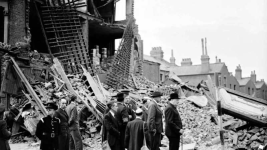
The Prime Minister Winston Churchill visits bombed out buildings in the East End of London on 8 September 1940.

  1. image.png

    Bomb damaged shops, Lower Road, Bermondsey. with Bermondsey Old Town Hall to the rear, 8 September 1940. © IWM (HU 131496)

    image.png

    A huge crater in the middle of the road at Elephant & Castle, 8 September 1940.
Some pictures of the aftermath of the Luftwaffe attacks of 7th Sept 1940.

By switching their attacks away from RAF Fighter Stations and turning to instead attack London.

They gave Fighter Command a much needed respite and this changed the course of The Battle of Britain and subsequently the entire Second World War.

 
image.png

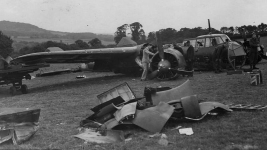
The wreckage of Junkers Ju 88A-1 (W.Nr. 0274, 4D+AA) of Stab/KG 30, shot down on 9 September 1940 at Newells Farm, Nuthurst, West Sussex, where it had been substantially ‘got at’ by souvenir hunters when this photograph was taken.

image.png

Firemen spray water on damaged buildings, near London Bridge, in the City of London on 9 September 1940.

image.png

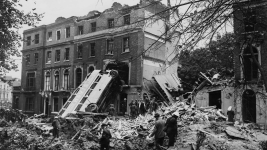
A bus is left leaning against the side of a building in Harrington Square, near Regents Park after a German bombing raid on London in the first days of the Blitz, 9 September 1940.

www.battleofbritain1940.com

 
Last edited by a moderator:
A programme worth listening to. About the Norman Conquest in 1066 and the impact on England and in later years, Scotland, Wales and Ireland. Also how it was viewed in France. 1066 was a time as France as we know didn't exercise. It was a country of different provinces e..g. Normandy and Brittany. Rulers in those provinces were vassals of French kings and had some autonomy. Whilst 1066 and subsequent years and events e.g. the building of castles and The Harrying of the North were seen as momentous occasions in England it was less so in France as in some ways Normans were seen as outsiders.

The Normans were fortunate in that they were able to use the shire system and local governance set up by the Anglo-Saxons and install Norman officials. William the Bastard as he was often described at the time gave much land to his half-brother Odo.

How different would England and the rest of the United Kingdom and the Republic of Ireland would be if the Anglo-Saxons had been successful. We can only speculate. It has often been said that the Norman Conquest was the last time that England was successfully conquered. I'm not so sure and I guess that could be down to what is meant by invasion. Do you limit it to military invasions or do you also include cultural, political and religious incursions and influences. If just military, what about the invasions of Henry IV an Henry VII where Richard II and Richard III were removed respectively and like William the Bastard had dubious claims to the English throne. Do you also include William III and Mary II coming to Britain in 1688 to replace James II. True, they had been invited my many of the leading politicians and churchmen.

sounds-apple-touch-icon.ead169771d.png
BBC
p0p6txpm.jpg
What Did the Normans Ever Do for Us? - BBC SoundsKatie Razzall asks why the Norman Conquest still matters today.
 
image.png

The aircrew of Heinkel He 111H-3 (1H+CB) of Stab I./KG 26 are marched off by the Home Guard after making a forced landing at Burmarsh, Romney Marsh, Kent in September 1940. Their burning aircraft lies in the background.

image.png

Firefighters battle a gas explosion from the previous night’s air raid, Kingsway, London, 11 September 1940.

 
Am going to an air show at Imperial War Museum, Duxford tomorrow. Should be good. It will mean that I'll miss our game against Hull City. I've given my ticket to a friend.

This year marks the 90th anniversary of the first flight of the Supermarine Spitfire so that aeroplane will feature greatly. Towards the end of the air show there will be a mass display of Spitfires and Hurricanes to replicate the Duxford Big Wing. The less said about 12 Group's Big Wing in the Battle of Britain the better. Do I try and avoid a debate about the rights and wrongs of Big Wing which was the idea of Leigh-Mallory and Bader. Possibly not.

Aeroplanes on display in the following link. So many great aeroplanes will fly and I'm especially looking forward to seeing the Flying Fortress, Catalina, Swordfish and Lysander. Goes without saying that it will be great to see the Spitfires, Hurricanes and Mustangs. Saying that I see Spitfires flying a couple of times a week.

https://www.iwm.org.uk/airshows/duxford-battle-of-britain-airshow/flying-list

 
The British Meacon SystemOriginally published. February 2016

Updated. December 2024

www.warhistory.org


Dornier Do 217 5.KG2 (U5+DN) Dora Nordpol Gunther Dolenga 12th Oct 1941-01

MEACON. British codename for transmitters located in England and designed to broadcast signals to interfere with enemy navigation beacons.

By August 1940, 80 Wing had built nine MEACONS, part of the ASPIRIN antidote for HEADACHE.

ASPIRIN. Royal Air Force codename for the transmitters across the country employed to disrupt the Luftwaffe’s navigational beams that guided bombers to their targets in England.

Some 2,000 personnel of 80 Wing operated 15 ASPIRIN sites, the electronic countermeasures taken to jam the enemy signals codenamed HEADACHE.

HEADACHE. British World  War II generic codename for the countermeasures taken to bend the navigational beams used by Luftwaffe bombers.

November 6, 1940A Luftwaffe bomber is brought down by a British radio beacon sending signals which convince the pilot that he is over France.

This may have been a result of the “Meaconing” subterfuge, set in operation in August 1940.

“Meaconing” is a system of receiving radio beacon signals and rebroadcasting them on the same frequency to confuse navigation.

The meaconing stations cause inaccurate bearings to be obtained by aircraft or ground stations. The Luftwaffe used radio frequency beacons (200-500 kcs) for general navigation.

These low power beacons are spread around German Occupied territory and transmit a continuous, omni directional carrier with a Morse identification on an allotted frequency.

The position of these beacons (acting somewhat like invisible lighthouses) are marked on German charts, and by using normal direction finding equipment, and two beacons, aircrew could “fix” their position.

The British set up receivers fitted with directional aerials (antennas) around the south and east coasts of England, and tuned into the enemy beacons.

The received signals are sent by landline to counterfeit beacon transmitters elsewhere in Britain which radiated the German beacon signal on the same frequency, but it was (obviously) from a false location.

However the German signal is changed, the counterfeit transmitter continues to reproduce it faithfully and deceive the enemy aircrew’s direction finding equipment.

This “masking” began in August 1940, and proves very successful.

A slight refinement is possible when German aircrews request a bearing from their ground station.

Then the aircraft transmitter would be re-radiated from a spurious ground transmitter which is DF’d by the ground crew, on the same frequency.

This was so that they might give a position report that could be as much as 100 miles (161 kilometers) in error.

The other Luftwaffe aid to navigation was a network of radio beacons, each with an indentifiable signal. Cross-bearings on two or more would give the bomber its precise location.

Here again British countermeasures intervened with masking beacons, or ‘Meacons’, which reproduced the original signals.

Many German bombers were led astray by these, and more than one was fooled into landing in England.

On 14/15 February 1941 Heinkel pilot Hans Thurner, of KG 55, was even stated to have touched down on three English airfields in the same sortie.

On each occasion he discovered his mistake in the nick of time, opened the throttles and made a hasty departure, eventually returning to base.

He was awarded the Ritterkreuz on 6 August 1941. One of the few bomber pilots to fly entirely in the West, as Kommandeur I/KG 6 (Ju 188) he failed to return on 11 June 1944.

He was awarded Eichenlaub posthumously on 20 September 1944.

 
image.png

Infantry troops departing for the Continent at Waterloo Railway Station. 16th August 1914.

A poignant photograph.

 
image.png

St Thomas’s Hospital in Lambeth which was badly damaged in an air raid during September 1940. © IWM (HU 59004)

image.png

Air raid damage, including the twisted remains of a double-decker city bus, in the City of London on 10 September 1940.

image.png

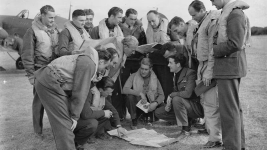
Czech and British pilots of No. 310 Squadron confer at Duxford, September 1940.

Pictured are Vaclav Bergman, Bohumir Furst, Rudolf Zima, Emil Fechtner, Stanislav Zimprich, Jan Kaucky, Karel Seda, Jaroslav Maly, Vilem Goth, Josef Vopalecky, Svatopluk Janouch, Raimund Puda, Gordon Sinclair, John Boulton and Jerrard Jeffries. © IWM (CH 1291)

image.png

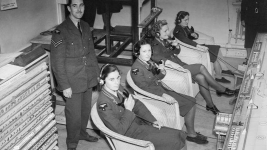
WAAF telephone operators in the Sector ‘G’ Operations Room at RAF Duxford, receiving reports of enemy aircraft plots from Observer Corps posts, September 1940. © IWM (CH 1404)

 
After Rome…Originally published. September 2015

Updated December 2024

www.warhistory.org


Anglo-Saxon warriors.


Vortigern greets Hengest and Horsa.


The Anglo-Saxon Chronicle, composed long after the events related, reports that in 449 ‘Hengist and Horsa, invited by Wyrtgeorn’ arrived in England; they had come to help the English against invaders, but they stayed only to fight against their hosts.

Hengist and Horsa mean respectively ‘horse’ and ‘mare’. Wyrtgeorn, or Vortigern, is simply the term for an overlord or over-king.

In some of the Welsh annals he is also known as Vortigern ‘of the repulsive mouth’.

So, as always, there are elements of mythology embedded within the history

The dates are also wrong.

The evidence suggests that in 430 Vortigern, the leader of the confederacy of small kingdoms into which much of the country had divided, called in Saxon mercenaries to defend England against the Picts from Scotland and various marauding bands from Ireland.

This was an old and familiar strategy, used by the Romanized English at various points in their history.

The Irish landed on the west coast, within easy reach of the Cotswolds; the central part of Vortigern’s kingdom lay in that hilly region, which may account for his leading role in the struggle.

It is reported that the Picts had landed in Norfolk.

The Pictish sailors painted their ships, and their bodies, the colour of the waves so that they could less easily be seen.

So the decision to call in the Saxons was born out of fear and urgency.

According to historical legend, they came in three ships, holding at best only a few hundred men.

There are likely to have been more ships but, in any case, these mercenaries were known for their ferocity as well as for their valour.

The bands of warriors, under a war chieftain, worshipped the sun and the moon.

They adored Woden, god of war, and Thor, god of thunder.

They practised human sacrifice. They drank from the skulls of their enemies.

The fronts of their heads were shaved, the hair grown long at the back, so that their faces might seem larger in battle.

‘The Saxon’, a Roman chronicler of the fifth century wrote, ‘surpasses all others in brutality. He attacks unforeseen, and when foreseen he slips away. If he pursues, he captures; if he flees, he escapes.’

The most significant elements of the Saxon force were stationed in Kent, and were given the island of Thanet in the Thames estuary.

Other bands of soldiers were placed in Norfolk, and on the coast of Lincolnshire.

The Icknield Way was guarded. London and the Thames estuary were defended.

The remains of the Romanized armies, still in the north, were stationed in a strongly fortified York.

Then, on the invitation of Vortigern, more Saxon mercenaries were brought to England.

The show of strength seems to have been enough. The Picts abandoned their plans for the invasion.

The Irish were in turn checked by the tribal armies of the west and the west midlands; the kingdom of the Cornovii, with its capital at Wroxeter, was instrumental in that repulse to the invaders.

Yet now a more insidious threat to Vortigern’s leadership emerged.

His allies, alarmed at the cost of the Saxon presence, could not or would not pay them.

They also refused to yield land in exchange for payment.

After the immediate threat had passed, they declined to subsidize their defenders.

According to the Kentish chronicles they declared that ‘we cannot feed and clothe you, because your numbers have grown. Leave us. We no longer need your assistance.’

The reaction of the mercenaries was immediate and strong.

Their insurgency began in East Anglia, and then spread down to the Thames Valley.

They took over many of the towns and countryside areas in which they had been stationed.

They appropriated large estates, and enslaved many of the native English.

They had seen at first hand the prosperity of the land and had acquired a taste for it.

Thanet itself, as a granary, was a golden prize.

The Saxon federates then sent out a call to their compatriots. Come and settle here. Together we can master the natives.

So the Germanic migrants kept on coming. Among them were four predominant tribes – the Angles from Schleswig, the Saxons from the territories around the river Elbe, the Frisians from the northern coast of the Netherlands, and the Jutes from the coast of Denmark.

There were no such people as ‘Anglo-Saxons’ until the chroniclers invented them in the sixth century.

The routes of settlement were already established by the river system. The settlers pushed along the Thames, the Trent and the Humber.

The Jutes settled in Kent, Hampshire and the Isle of Wight; the New Forest was once Jutish land.

The Saxons were established in the Upper Thames valley.

The Frisians were scattered over the south-east, with an important influence in London.

The Angles settled in eastern and north-eastern England; by the early sixth century the people of east Yorkshire were wearing Anglian clothes.

These were small tribes, small communities under a leader or leading family.

Some were resisted; some were welcomed. Others were simply accepted by a working population who had no real love for their earlier native masters.

All were accommodated and, according to the best genetic evidence, eventually made up 5 per cent of the population we now call English.

In the eastern regions it may have reached approximately 10 per cent, but there is no hint of deliberate genocide and replacement of the native population.

They came because they were being pushed by other tribes in the great westward migrations of that era, but they also came because their ancestral lands were in peril from the rising sea.

This was the period in which the northern European coastline was sinking, as the archaeological evidence from Germany and the Netherlands testifies; there was urgent need to find land elsewhere.

The revolt of the Saxon federates was a decisive blow to the prestige and authority of Vortigern.

He was overthrown by another Romanized English leader, Ambrosius Aurelianus, who led a counter-attack upon the Saxons and for ten years engaged in a series of strenuous battles.

In 490 the English won a great victory at a place known to posterity as Mons Badonicus, believed to be near modern Bath.

The leader of the English forces on that occasion is not recorded, but in this period the name of Arthur emerges as over-king. He is a shadow in the historical record, known only as dux bellorum or ‘leader of warfare’.

He is said to have participated in twelve battles against the Saxons, but the places cannot now be identified.

In the pages of the medieval romances he is a great king with a shining court at Camelot, otherwise known as Winchester.

In truth he may have been a military commander, whose headquarters were within the hill fort of Cadbury.

18 acres (7.2 hectares) of that hill fort were enclosed in the period of Arthur’s supposed lifetime.

The English had survived but, as part of the spoils of war, the Saxons retained their control over Norfolk, East Kent and East Sussex.

There was a division in the country, perhaps marked by the construction of the Wansdyke designed to keep the Germanic people from crossing into central southern England.

On one side of that barrier were small English kingdoms; on the other, Germanic tribes with their warrior leaders.

What had previously been some of the most Romanized parts of the country had become the home of ‘barbarians’.

The town and villa life of these regions was, therefore, in abeyance.

An English chronicler of the early sixth century, Gildas, laments that ‘the cities of our country are still not inhabited as they were; even today they are squalid deserted ruins’.

This was the process of the Saxon ‘invasion’.

Yet some towns and cities were still in active use, as markets and places of authority.

It is well known that the Saxons set up their own trading area outside the walls of London, in the district now known as Aldwych.

However, the old city was still a place of royal residences and public ceremonial.

In the countryside, there is even greater evidence for continuity of settlement.

It is not to be expected that any change in agricultural practice took place.

The same field systems were laid out by the Germanic settlers; the new arrivals respected the old boundaries and in Durham, for example, Germanic structures were set within a pattern of small fields and drystone walls created in the prehistoric past.

More surprisingly, perhaps, the Germanic settlers formed groups that honoured the boundaries of the old tribal kingdoms.

They respected the lie of the land.

The sacred sites of the Saxons, at a slightly later date, follow the alignment of Neolithic monuments. All fell into the embrace of the past.

The Germanic settlers were kept within their boundaries by the English for two or three generations.

It should not be forgotten that, in this period, the average life expectancy was thirty-five years.

It was a country of young men and women, with all the energy and thoughtlessness of the young. The leaders of the country were brash, vibrant and energetic.

By the middle of the sixth century the Germanic people wished to move further west, and to exploit the productive lands that had previously been beyond their grasp.

There are many reasons for this sudden efflorescence of activity, but one of the most convincing lies in the onset of deadly plague in the 540s.

Bubonic, and perhaps pneumonic, plague spread from Egypt all over the previously Romanized world.

It seems that it struck down the native English rather than the settlers, with a force and scope that rival the great plagues of the thirteenth and seventeenth centuries.

Some actuarial experts suggest that a population of 3 or 4 million now dropped to 1 million.

The land was left vacant, and fewer men were available to defend it.

So the Angles, and the Saxons, moved westward. Anglo-Saxon civilization was created by a pandemic.

One of the leaders of the Saxons, Ceawlin, had reached as far as Cirencester, Gloucester and Bath by 577; seven years later his forces had penetrated the midlands.

The native kings were thereby deposed.

This was the pattern throughout the country.

The pressure was growing on the Durotriges of Somerset and Dorset and as a result there was an exodus of native people to Armorica, on the Atlantic coast of north-western France, where their leaders took control of large tracts of land.

They may have been welcomed.

They were perhaps part of the same tribe. So the region of Brittany emerged.

The Bretons in fact retained their old tribal allegiances, and never really thought of themselves as part of the French state.

Some of them came back.

A Breton contingent was among the forces of William the Conqueror, which chose to settle in south-west England. They had come home at last.

In the end the natives would be so mixed and mingled with the new settlers that the term Saxon or Angle ceased to have any meaning.

All would become English.

Yet it was a slow process.

Much of western England was still under the rule of native kings 200 years after the first Saxons arrived

The native kingdom of Elmet, now known as the West Riding of Yorkshire, survived until the early seventh century and the ‘Anglo-Saxon invasion’ only came to an end with the capture of Gwynedd by Edward I in 1282.

Celtic speakers were to be found in Cornwall at the beginning of the sixteenth century, and the language did not wholly die until the eighteenth century.

The settlements of the Germanic tribes took the form of small folk territories, made up of groups of warriors and marked off by river boundaries.

So the followers of Haesta created Hastings and the followers of Gilla established Ealing.

The people of the Peak district, the people of the Chilterns, and the people of the Wrekin, were all given distinct topographical names.

Jarrow means ‘among the Jyrwe’, a small tribe found in the fen district as well as in Northumberland.

The immense number of small tribes was gradually aligned for the purposes of defence or warfare.

Over-kings emerged as the leaders and protectors of tribal chiefs, and by 600 the recognizable kingdoms of Anglo-Saxon England begin to enter recorded history

The kingdom of the East Angles was formed together with those of the East Saxons and the Mercians.

These were societies of rank, based upon a structure of burdens and obligations imposed by the warlords and their entourage.

There were slaves, there were landless workers, there were ceorls or free heads of households, and there were thegns or noblemen, with all possible divisions and distinctions within each rank.

The financial penalties for murder, for example, were graded according to the ‘worth’ of the victim.

It was a harsh and divisive society, only made possible by the continuous exploitation of the unfree.

In that respect, it may not have differed very much from any previous English polity.

There never was any Rousseau-esque state of equality in nature. There always was a system of lordship and vassalage.

 
image.png

On the morning of 13th September 1940, incendiary and high explosive bombs fell on Buckingham Palace, damaging the courtyard and the chapel.

King George VI and Queen Elizabeth were in residence at the time.

The Victoria memorial outside the palace was damaged too.

The Queen was later to comment: “I’m glad we have been bombed. Now I can look the East End in the face.”

 
image.png

A Hawker Hurricane Mk.I of No. 73 Squadron is refuelled and rearmed.

image.png

Armourers rearming a Hawker Hurricane Mk.I of No. 73 Squadron.

The Ground Crews provided an essential part of the RAF defence during The Battle of Britain.

Often unsung, the pilots knew just how important a role they played.

 
Heavy attacks on London, broken up by Fighter Command. Highest German losses since 18 August [185 claimed by the RAF] force a serious rethink by the German High Command.Night: Heavy damage to London.

Weather: Fair with some cloud patches. Fine during the evening.

www.battleofbritain1940.com

By mid-September 1940, the Luftwaffe’s campaign against Fighter Command had reached a critical juncture. Adolf Hitler had set a provisional date of 17 September for Operation Sea Lion, contingent on German air superiority being achieved.

With time running out and the autumn weather becoming increasingly unpredictable, Reichsmarschall Hermann Göring issued orders on 14 September for a maximum-effort daylight assault on London the following day.

It would be the fifth large-scale attack on the capital and was intended to crush British morale and destroy the last of Fighter Command’s strength.

Specific flight paths and bombing altitudes were distributed to bomber Gruppen.

While the Germans remained unaware of the limitations of British radar above 20,000 feet, they had begun flying at higher altitudes in the belief that such tactics had delayed RAF interceptions in recent raids.

Despite repeated promises that one final blow would bring victory, morale among German aircrews was low.

Luftwaffe crews had been told in July and again in August that Fighter Command was nearly defeated, yet every raid met fierce resistance.

As General Adolf Galland later recalled:

“Failure to achieve any notable success, constantly changing orders betraying lack of purpose and obvious misjudgment of the situation by the Command… had a most demoralizing effect on us, the fighter pilots, who were already overtaxed by physical and mental strain.”
In Britain, the picture was different. Fighter Command had recovered much of its operational strength.

Airfields had been repaired, aircraft losses replenished, and radar stations were restored to full capacity.

The Luftwaffe’s daily bombing of aerodromes had not succeeded in breaking down the system.

By 15 September, the RAF was ready.

Enemy Action by DayWeather over southern England had cleared after overnight rain, with fine conditions prevailing beneath a broken cloud base.

At RAF Uxbridge, Air Vice-Marshal Keith Park received early radar reports indicating increased German aerial activity over northern France.

That morning, Prime Minister Winston Churchill visited No. 11 Group headquarters.

At the time of his arrival, the plotting tables showed little more than scattered reconnaissance tracks, and WAAF personnel continued their duties as normal.

The first daylight combat occurred shortly after 08:00 hours. A Heinkel He 111 from Aufklärungsgruppe 51, engaged in long-range reconnaissance, was intercepted over the Channel by Hurricanes of No. 87 Squadron and shot down.

A Heinkel He 59 air-sea rescue aircraft was dispatched to search for survivors but found no trace of the bomber or its five-man crew.

Further high-altitude reconnaissance flights by Ju 88s penetrated deep into Britain during the morning, photographing targets ranging from RAF Sealand and Chatham Dockyard to Manchester and Liverpool.

These aircraft flew above the effective interception ceiling, and all returned safely.

Though these early movements caused no damage, their scale and pattern suggested that a major operation was imminent.

10:10–13:00 Hours: The Noon AttackAt 10:10 hours, the first major German formation became airborne. Major Alois Lindmayr, Gruppenkommandeur of I./Kampfgeschwader 76, led the attack.

A veteran of the French campaign and holder of the Knight’s Cross, Lindmayr commanded a force of Dornier Do 17s drawn from both I. and III./KG 76. III./KG 76 contributed 19 aircraft from Cormeilles-en-Vexin, while I./KG 76—reduced by attrition—could muster only eight serviceable bombers.

As a result, two Gruppen were committed to perform the task normally assigned to one.

The formation rendezvoused over Amiens before proceeding toward Cap Gris-Nez to meet its fighter escort. En route, cloud disrupted cohesion, delaying the force by approximately ten minutes while it reformed.

Two bombers failed to rejoin and returned to base. Among the attacking aircraft was a Dornier piloted by Feldwebel Rudolf Heitsch, experimentally fitted with a rear-mounted infantry flamethrower intended to deter close pursuit.

At 10:30 hours, Chain Home radar stations—particularly Dover—reported a hostile concentration forming over the Pas-de-Calais. The filter room at Stanmore confirmed the tracks, and group and sector commands were alerted that more than forty aircraft were entering Kentish airspace.

By 11:04 hours, Lindmayr’s force had reached Calais. Wing Commander Lord Willoughby de Broke, Park’s senior controller, observed the raid’s progress alongside Park and the Prime Minister, uncertain whether the plots represented bombers or fighter sweeps.

Park elected to gamble. At 11:15 hours, he committed nine squadrons from Biggin Hill, ordering Nos. 72 and 92 Squadrons to patrol at 25,000 feet over Canterbury. No. 603 Squadron was to follow and attack the close escort. Further squadrons were held in readiness at Northolt, Kenley, Debden, Hornchurch, and North Weald.

The bombers crossed the English coast at Folkestone at 11:36 hours. Escorting them were Bf 109s from JG 27 and I./JG 52 at medium altitude, JG 53 providing top cover, and approximately thirty aircraft from JG 3 flying close escort. Elements of Lehrgeschwader 2 operated ahead of the main force.

A strong headwind slowed the Dorniers, increasing fuel consumption among the Bf 109s while simultaneously aiding RAF fighters climbing from the north.

By 11:50 hours, Spitfires of Nos. 72 and 92 Squadrons attacked from above, breaking up JG 53’s high cover. No. 603 Squadron soon joined the engagement against JG 3’s close escort.

While Hurricanes of Nos. 253 and 501 Squadrons pressed home head-on attacks against the bombers, holding formation under intense defensive fire. Additional RAF squadrons entered the battle as the fighting spread across Kent and south-east England.

During these opening engagements, German fighter losses mounted rapidly. At approximately 12:00 hours, a Bf 109E-4 (W.Nr. 3182) of 1./JG 52 was shot down over Ashford by Pilot Officer G. H. Bennions of No. 41 Squadron and Pilot Officer C. A. McGaw of No. 73 Squadron. The aircraft crashed at Dering Wood, Berry Court, Biddenden Green, after Lt. H. Bertel baled out and was captured.

At 12:07 hours, as the outskirts of London came into view, the Bf 109 escorts began disengaging and turning back towards France as fuel reserves ran low—precisely the effect Park had intended through his policy of continuous interception along the bombers’ route.

The Dorniers pressed on and released their bombs over London, striking rail lines near Battersea Park on the south bank of the Thames. Although tracks and a viaduct were damaged, repairs were completed within days.

Bader’s Duxford Wing—Nos. 19, 242, 302, 310, and 611 Squadrons—arrived over London and immediately engaged the German formations as they began their bombing run.

Around the same time, at 12:09 hours, Flying Officer A. D. J. Lovell and Pilot Officer J. D. Smith of No. 73 Squadron destroyed a Bf 109E-4 (W.Nr. 5197) of 1./JG 53 during combat over Canterbury. The fighter crashed at Adisham Court, Bekesbourne, and Fw. H. Tschoppe baled out and was captured, though severely burned.

At 12:15 hours, Pilot Officer R. H. Holland of No. 92 Squadron shot down a Bf 109E-4 (W.Nr. 5205) of JG 3 near Bilsington. The aircraft crashed into outbuildings at Tarpots Farm, and Oberstlt. H. von Wedel was captured.

As the German escorts withdrew, Hurricanes of Nos. 504 and 257 Squadrons intercepted the trailing Dorniers over south London. One bomber, a Do 17Z (W.Nr. 2361, F1+FH) of 1./KG 76 flown by Oblt. R. Zehbe, had fallen behind the formation with engine trouble and came under repeated attack from Flight Lieutenant J. Jefferies, Sergeants J. Hubáček, R. Půda, and J. Kaucký of No. 310 Squadron, Pilot Officers J. Curchin and A. K. Ogilvie of No. 609 Squadron, Flying Officer P. T. Parsons of No. 504 Squadron, and Pilot Officer A. C. Cochrane of No. 257 Squadron.

The bomber was finally destroyed when Sergeant Ray Holmes of No. 504 Squadron collided with it during the engagement.

The Dornier disintegrated in the air and crashed onto the forecourt of Victoria Station. Bombs released during its descent fell near Buckingham Palace, causing damage but failing to explode.

Uffz. H. Goschenhofer and Uffz. G. Hübel were killed. Zehbe baled out and landed in Kennington, where he was attacked by civilians; he later died of his wounds. Obgfr. L. Armbruster and Uffz. L. Hammermeister also baled out and were captured.

Holmes escaped by parachute, injured but alive.

Contrary to later popular accounts, Holmes’s combat report did not describe a deliberate ramming.

The incident nevertheless became embedded in public mythology as an emblem of desperate resistance.

The escort formations continued to suffer losses as the battle spread. At 12:30 hours, Sergeant D. G. S. R. Cox of No. 19 Squadron destroyed a Bf 109E-1 (W.Nr. 6147) of 2./JG 27. The aircraft crashed at Lodge Wood, Homestead, Isfield, near Uckfield, and Uffz. A. Walburger was captured.

At 12:42 hours, Flight Sergeant C. Sydney of No. 92 Squadron shot down a Bf 109E-1 (W.Nr. 3619) of 3./JG 53 over London. The aircraft force-landed at Grand Redoubt between Hythe and Dymchurch, and Uffz. K.-H. Feldmann was captured.

Shortly afterwards, at 12:45 hours, Pilot Officer J. F. J. MacPhail of No. 603 Squadron destroyed a Bf 109 of 2./JG 53 during combat over Maidstone. The aircraft crashed at Gore Wood, Aldington Court Farm, Bearsted, killing Oblt. R. Schmidt, who was later buried in St Mary’s churchyard, Thurnham.

Further losses followed. At 12:50 hours, a Bf 109E-4 (W.Nr. 1590) of 3./JG 53 was shot down over London by Flight Sergeant G. C. Unwin of No. 19 Squadron and Flying Officer A. D. Nesbitt of No. 1 (RCAF) Squadron. The aircraft crashed at Mullard Wood, Norheads Farm, Biggin Hill. Oblt. J. Haase baled out but was killed when his parachute failed to open.

KG 76’s formation had been shattered under continuous RAF attack. Six Dorniers were destroyed and many others badly damaged as the surviving bombers withdrew under increasingly limited escort.

Among the losses was a Do 17Z (W.Nr. 2555, F1+FS) of 8./KG 76 equipped with an experimental flame-throwing device, which malfunctioned at altitude, spraying oil.

At 12:10 hours, the bomber was brought down by Flying Officer J. C. Dundas and Pilot Officer E. Q. Tobin of No. 609 Squadron together with anti-aircraft fire while taking part in the raid on London’s docks.

The aircraft force-landed at Castle Farm, Shoreham. Fw. S. Schmid was captured but later died of his wounds, while Fw. H. Pfeiffer, Fw. M. Sauter, and Fw. R. Heitsch were captured.

At 12:20 hours, another Do 17Z (W.Nr. 2578, F1+BS) of 8./KG 76, was shot down by Pilot Officer A. R. H. Barton of No. 253 Squadron and crashed into the sea off Herne Bay. The body of Fw. L. Keck later washed ashore at Herne Bay on 29 September, while Uffz. G. Rosenow’s body came ashore at Southwold on 15 October. Uffz. O. Zahn and Uffz. H. Heitmann were posted missing, believed killed.

At the same time, a Do 17Z (W.Nr. 2814, F1+AT) of 9./KG 76 was shot down over London by Flight Sergeant J. Komínek of No. 310 Squadron, Sergeants C. A. L. Hurry and G. W. Jefferys of No. 46 Squadron, and Pilot Officer V. M. M. Ortmans and Sergeant R. J. Ommaney of No. 229 Squadron.

The aircraft crashed at Argos Hill Lodge, Red Lane Farm, Rotherfield. Obgfr. K. Böhme, Gefr. J. Kotone, and Lt. A. Wagner were killed, while Gefr. P. Holdenried attempted to bale out but became entangled in the tailplane and was also killed.

At 12:30 hours, a Do 17Z-2 (W.Nr. 3322, F1+DT) of 9./KG 76 was brought down during combat over London by Sergeant E. Tyrer of No. 46 Squadron, Flight Lieutenant R. F. Rimmer of No. 249 Squadron, Flight Lieutenant P. M. Brothers and Pilot Officer P. A. Mortimer of No. 257 Squadron, Sergeant E. W. Wright of No. 605 Squadron, and Pilot Officer H. N. Tamblyn of No. 242 Squadron.

The aircraft crashed at Underriver, Sevenoaks. Oberfw. H. Streit, Fw. W. Seuffert, and Fw. W. Raab baled out and were captured, but Uffz. E. Malter was killed when his parachute fouled the aircraft.

Ten minutes later, a Do 17Z-3 (W.Nr. 2651, F1+FL) of 3./KG 76 was shot down by Pilot Officer J. R. B. Meaker of No. 249 Squadron, Flight Lieutenant W. J. Leather, Flying Officer T. D. Williams, and Pilot Officer P. S. C. Pollard of No. 611 Squadron, Flight Lieutenant K. McL. Gillies and Pilot Officer C. A. W. Bodie of No. 66 Squadron, and Flight Lieutenant J. W. Villa of No. 92 Squadron.

The aircraft crashed at Alcrofts Farm, Sturry. Oberfw. K. Niebler, Fw. K. Wissmann, and Uffz. J.-F. Schatz were killed, while Oblt. K.-E. Wilke and Uffz. H. Zrenner baled out and were captured.

By 13:00 hours, the first phase of the battle had ended. Churchill, watching the plots clear from the operations table, expressed satisfaction as RAF squadrons returned to refuel and rearm.

Of the Duxford Wing’s fifty-six aircraft, only forty-nine remained serviceable for the afternoon fighting.

13:45–15:45 Hours: The Afternoon AttackEven as KG 76’s survivors landed in France, a far larger second wave was assembling.

Bomber units from KG 2, KG 3, KG 26, and KG 53 took off to attack the London docks and industrial targets north and south of the Thames.

In total, 114 bombers advanced in four columns, supported by a powerful fighter screen from JG 3, JG 26, JG 53, JG 77, and elements of LG 2 and ZG 26.

Chain Home detected the raid at 13:45 hours. Park ordered successive waves of interceptions, eventually committing nearly every available squadron.

By 14:20 hours, the RAF had 276 fighters airborne, though the Germans still enjoyed a numerical advantage—particularly in Bf 109s.

Initial engagements erupted over Romney Marsh, where Spitfires of Nos. 41, 92, and 222 Squadrons clashed with JG 26.

At 14:20 hours, a Bf 109E-4 (W.Nr. 2803) of 9./JG 51 was shot down during combat with RAF fighters and crashed at Skinners Corner, Mascalls, near Paddock Wood, killing Lt. F. Klotz.

Ten minutes later, Pilot Officer W. Cunningham of No. 19 Squadron brought down a Bf 109E-4 (W.Nr. 3266) of 7./JG 51 during combat near Dover. The fighter crashed at Nelson Park, St Margaret’s-at-Cliffe, and Lt. K. Bildau baled out and was captured.

At 14:45 hours, Flying Officer L. A. Haines of No. 19 Squadron destroyed a Bf 109E-7 (W.Nr. 2058) of 3./LG 2 during combat over London. The aircraft crashed at Shellness, and Uffz. A. Klick was captured.

Hurricanes from Nos. 213 and 607 attacked KG 3 head-on, followed by further assaults from Nos. 605 and 501 Squadrons. Despite losses, the Dorniers pressed on, reaching the Thames at 14:31 under heavy anti-aircraft fire.

At approximately 14:35 hours, Churchill stood beside Park in the Uxbridge operations room, watching as every squadron marker was committed. Turning to Park, he asked quietly,

“What other reserves have we?”
Park replied,

“There are none.”
The decisive fighting unfolded near Gravesend. Do 17s of KG 3 and He 111s of KG 26 were intercepted by Hurricanes from Nos. 17, 46, 249, 257, 504, and 603 Squadrons.

Three Dorniers were destroyed in the opening attacks, including the aircraft of Hauptmann Ernst Püttmann. KG 53 and KG 2 were then engaged in turn by Spitfires and Hurricanes from Nos. 1 (RCAF), 66, 72, 73, 229, 253, and 303 Squadrons.

Cloud hindered interception accuracy but also obscured targets.

At 14:45 hours, approximately 100 bombers dropped 120 tons of ordnance, concentrating on West Ham after failing to locate the Surrey Commercial Docks. The Bromley-by-Bow gasworks was badly damaged.

Upton Park station was hit, and surrounding residential districts were devastated. Seventeen civilians were killed and more than a hundred injured.

As fuel reserves dwindled, the Bf 109 escorts began withdrawing, leaving the bombers increasingly exposed. The Dorniers of KG 3 suffered catastrophic losses.

At 14:23 hours, a Do 17Z-2 (W.Nr. 3294, 5K+DM) of 4./KG 3 was shot down by Pilot Officer A. E. Johnson of No. 46 Squadron, Pilot Officers H. P. Hill and D. G. Williams of No. 92 Squadron, Pilot Officer R. G. A. Barclay of No. 249 Squadron, Flying Officer B. van Mentz of No. 222 Squadron, Flying Officer P. S. Turner of No. 242 Squadron, and Flying Officer J. R. Hardacre of No. 504 Squadron. The aircraft crashed at Gladstone Road, Laindon Hills, Billericay. Lt. K. Dumler, Uffz. H. Maskolus, and Fw. A. Vogel were killed, while Uffz. G. Friebe baled out and was captured.

At 14:30 hours, a Do 17Z-2 (W.Nr. 4200, 5K+JN) of 5./KG 3 was rammed during combat over London by Pilot Officer T. P. M. Cooper-Slipper of No. 605 Squadron. The Dornier crashed into Widehurst Woods near Marden. Oberfw. E. Rilling baled out too low and was killed, while Oberfw. H. Howind, Oberfw. H. Hobel, and Fw. E. Zimmermann parachuted safely and were captured.

Fifteen minutes later, Squadron Leader J. Sample of No. 504 Squadron and anti-aircraft fire brought down a Do 17Z-2 (W.Nr. 3457, 5K+JM) of 4./KG 3 over London. The bomber crashed into houses in Perry Street near Barnehurst Golf Course, Dartford. Uffz. K. Hausburg baled out but was killed when his parachute failed to open, while Lt. H. Michaelis and Flgr. H. Bormann were captured. Uffz. W. Burbulla later died of wounds in Dartford Hospital.

At almost the same moment, a Do 17Z-3 (W.Nr. 2881, 5K+CM) of 4./KG 3 was shot down by Flight Lieutenant E. N. Ryder and Flying Officer J. G. Boyle of No. 41 Squadron, Flying Officer S. Fejfar of No. 310 Squadron, Pilot Officer R. Berry of No. 603 Squadron, and anti-aircraft fire. The aircraft force-landed at Lower Stoke on the Isle of Grain, and all four crew members were captured.

At 15:00 hours, a Do 17Z-2 (W.Nr. 1176, 5K+DN) of 5./KG 3 was shot down during combat over London and crashed into the Thames Estuary. Fw. K. Falke baled out and was captured, while Hptm. E. Püttmann and Oblt. A. Langenheim were posted missing, believed killed.

Fifteen minutes later, Pilot Officer P. J. T. Stephenson of No. 607 Squadron destroyed a Do 17Z-3 (W.Nr. 3458, 5K+GN) of 5./KG 3 during combat over the Thames. The aircraft crashed at Combwell Wood, Kilndown, near Goudhurst. Oblt. H. Becker-Ross, Oberfw. G. Bruckner, Fw. A. Hansen, and Fw. W. Brinkmann were all killed and later buried in All Saints Churchyard, Staplehurst.

KG 2 likewise suffered heavily as RAF squadrons attacked the withdrawing bombers across Kent and the Thames Estuary. At 14:45 hours, a Do 17Z-2 (W.Nr. 3230, U5+ET) of 9./KG 2 was shot down by Squadron Leader J. E. McComb, Flying Officers M. P. Brown and T. D. Williams, and Pilot Officer J. W. Lund of No. 611 Squadron. The aircraft crashed at Cranbrook. Uffz. R. Lenz, Uffz. O. Krummheuer, and Fw. H. Glaser were killed, while Uffz. J. Sehrt baled out and was captured.

At 15:05 hours, a Do 17Z (W.Nr. 3440, U5+PS) of 8./KG 2 was brought down by Sergeant R. A. Innes of No. 253 Squadron, Flying Officer R. W. Oxspring of No. 66 Squadron, Pilot Officer H. P. Hill of No. 92 Squadron, and anti-aircraft fire. The bomber crashed at The Chase, City Way, Chatham, and all four crew members baled out and were captured.

At 15:15 hours, Pilot Officer A. Lyall of No. 602 Squadron, Squadron Leader H. S. Darley, Flying Officer J. C. Dundas, and Pilot Officer M. E. Staples of No. 609 Squadron, together with Flight Lieutenant G. ff. Powell-Shedden of No. 242 Squadron, shot down a Do 17Z-3 (W.Nr. 2678, U5+CN) of 5./KG 2. The aircraft force-landed at Eighteen Pounder Farm, Westfield, near Hastings. Uffz. F. Reinisch, Oblt. U. Latz, and Fw. K. Haase were captured, while Oberfw. W. Hafner baled out and was believed to have drowned.

Another Do 17Z (W.Nr. 3405, U5+FT) of 9./KG 2 was shot down during combat over the Thames Estuary by Pilot Officer W. B. Pattullo of No. 46 Squadron and Pilot Officer B. G. Stapleton of No. 603 Squadron. The aircraft crashed into the sea off Herne Bay. The body of Uffz. H. Hoppe later washed ashore on the Isle of Sheppey, while Oberfhr. K.-O. Staib’s body was recovered at Graveney Marsh on 30 September. Gefr. A. Hoffmann and Gefr. J. Zierer were rescued by a Royal Navy launch.

The Heinkel formations of KG 26 and KG 53 also suffered severe losses as the fighting continued unabated. At 14:30 hours, Pilot Officer R. Mottram of No. 92 Squadron shot down a He 111H-2 (W.Nr. 5718, A1+LN) of 5./KG 53 during combat over London. The aircraft force-landed at Trafford Farm, Benenden. Fw. O. Maier and Gefr. A. Hoffmann were killed, while Lt. H. Bansch, Uffz. S. Bauer, and Uffz. E. Buttler were captured.

At 14:50 hours, Sergeant B. Furst of No. 310 Squadron and Flying Officer B. D. Russell of No. 1 (RCAF) Squadron brought down a He 111H-2 (W.Nr. 3140, A1+DA) of KG 53 during a bombing mission against Beckton Gasworks. The aircraft crashed at Woolwich Arsenal. Fw. A. Benz, Fw. A. Schweiger, Uffz. H. Meyer, and Uffz. G. Geiger were killed, while Fw. M. Cionber baled out badly injured and was admitted to the Royal Herbert Hospital.

Five minutes later, a He 111H-2 (W.Nr. 5120, A1+EL) of 3./KG 53 was shot down during a raid on London’s docks and force-landed at Horstead Hall, Botany Farm. Fw. F. Grotzki was killed, while Uffz. A. Gerding, Lt. H. Boeckh, Uffz. K. Altmann, and Obergefr. R. Kurzawski were captured.

At 15:00 hours, a He 111H-4 (W.Nr. 6985, 1H+IH) of 1./KG 26 was shot down over London by Squadron Leader E. A. McNab of No. 1 (RCAF) Squadron, Sub-Lieutenant A. G. Blake of No. 19 Squadron, Pilot Officer H. C. Baker of No. 41 Squadron, Pilot Officers A. C. Cochrane and P. A. Mortimer of No. 257 Squadron, and Sergeant E. M. C. Prchl of No. 310 Squadron. The bomber force-landed at Asplens Head, Foulness, and all five crew members were captured.

At the same time, a He 111H-1 (W.Nr. 2771, A1+AN) of 5./KG 53 was brought down during combat by a large concentration of RAF fighters, including aircraft from Nos. 1 (RCAF), 66, 92, 229, 238, 242, 249, and 504 Squadrons. The bomber force-landed at West Malling airfield. Obergefr. E. Sailler and Gefr. H. Lange were killed, while Uffz. O. Zilling, Fw. R. Lichtenhagen, and Fw. K. Behrendt were captured.

Thirty minutes later, Pilot Officer H. P. Hill of No. 92 Squadron shot down a He 111H-2 (W.Nr. 5481, A1+GL) of 3./KG 53 over London. The aircraft crashed at Bourne Farm, Sandhurst. Uffz. A. Lehner and Fw. K. Rothig were killed, while Oblt. G. Buchner, Gefr. H. Stamminger, and Gefr. H. Richter baled out and were captured.

Meanwhile, RAF fighters continued to inflict losses on the withdrawing escorts. At 15:00 hours, Pilot Officer D. W. Crowley-Milling of No. 242 Squadron shot down a Bf 109E-1 (W.Nr. 2685) of 1./JG 3 over London. The aircraft crashed at St Michael’s, Tenterden, and Oberfw. F. Hessel baled out and was captured.

At the same time, a Bf 109E-7 (W.Nr. 2061) of 1./LG 2 was brought down over London by Sergeant M. Wojciechowski of No. 303 Squadron and Sergeant G. J. Bailey of No. 603 Squadron. The fighter crashed at Hartlip Churchyard, Rainham, and Uffz. H. Streibing baled out and was captured.

At 15:15 hours, a Bf 110C-3 (W.Nr. 3802, L1+IH) of 13./LG 1 was shot down during combat with RAF fighters and crashed at Rippers Cross, Hothfield Farm, Ashford. Oblt. H. Müller was killed, while Fw. A. Hoffmann later died of his wounds.

Fifteen minutes later, a Bf 109E-4 (W.Nr. 1606) of 3./JG 3 was shot down by RAF fighters and crashed at Thorn Farm, Pluckley Brickworks. Oblt. H. Reumschüssel baled out and was captured. Another fighter lost during the withdrawal was a Bf 109E-4 (W.Nr. 3759) of 1./JG 77, which crashed at Stutfall Castle, Lympne, killing Oblt. H. Kunze.

By 15:45 hours, the surviving formations were streaming back across the Channel in disarray.

At 16:00 hours, Pilot Officer D. G. Williams of No. 92 Squadron, together with anti-aircraft fire, brought down a He 111H-3 (W.Nr. 6843, A1+GM) of 2./KG 53. The aircraft crashed at Peasridge Farm, Frittenden, near Staplehurst. Major M. Gruber, Oblt. H.-P. Schierning, Fw. M. Nagl, and Oberfw. G. Schmidt baled out and were captured, while Fw. A. Grassi was killed.

KG 2 lost eight Do 17s, KG 3 a further six, while KG 53 suffered the loss of six He 111s, including the aircraft of Major Max Gruber. Although RAF claims greatly exceeded the Luftwaffe’s actual losses, German casualties were nevertheless severe.

Other Daylight and Evening RaidsAt approximately 15:00 hours, more than twenty unescorted He 111s from III./KG 55 attempted an attack on naval targets at Portland. They were intercepted by Spitfires of No. 152 Squadron, suffering losses while inflicting only minor damage.

At 17:40 hours, aircraft from Erprobungsgruppe 210 attacked Southampton, aiming at the Spitfire factory at Woolston. Despite intense anti-aircraft fire, the factory escaped destruction, though nearby residential areas and infrastructure were damaged, causing civilian casualties.

Further minor reconnaissance and nuisance raids occurred into the evening.

Enemy Action by NightNight bombing began at 22:48 hours when KG 27 attacked Liverpool, causing widespread damage but relatively few casualties. Additional raids struck Eastbourne, Worthing, Bournemouth, Cardiff, Bristol, Manchester, and towns across the Midlands and North West.

RAF night fighters flew 64 sorties and intercepted several aircraft but achieved no confirmed victories.

SummarySunday, 15 September 1940, was a decisive turning point in the Battle of Britain.

Fighter Command, fully committed, had repelled two of the largest coordinated attacks of the campaign.

The Luftwaffe suffered unsustainable losses.

Hitler’s assumption that the RAF was on the verge of collapse was conclusively disproved.

Operation Sea Lion was postponed indefinitely.

This day—later commemorated as Battle of Britain Day—marked the moment when the strategic initiative in the air war shifted firmly to Britain.

As Churchill watched from the operations room at Uxbridge, he understood the significance. Britain had not only survived—it had fought back and won.

German Losses:
Airmen: 93 | Aircraft: 61

British Losses:
Airmen: 16 | Aircraft: 31

 
Last edited by a moderator:
image.png

Squadron Leader Rupert Leigh of No. 66 Squadron climbs into his Spitfire Mk I, R6800 LZ-N, at Gravesend, September 1940. © IWM (HU 104504)

image.png

The final moments of Dornier Do 17Z-2 ‘F1+FH’ (Wk-Nr 2361) of 1.Staffel/KG 76, brought down by Sergeant Ray Holmes of No. 504 Hurricane Squadron on 15 September, 1940.

image.png

Soldiers survey the carnage after a Dornier Do 17 bomber crashed onto the forecourt of Victoria Station following a mid-air collision with Sergeant Ray Holmes’ Hurricane on 15 September 1940 over central London.The shop of well-known clock supplier James Walker Ltd was badly damaged and a mass of mantel clocks are scattered across the pavement.

image.png

The wreckage of the Hurricane that collided with a Dornier Do 17 bomber on 15 September 1940, is placed near Buckingham Palace Road in central London. The crater that contained the Rolls-Royce Merlin engine and other wreckage was simply filled in and covered over.

In 2004, the engine was recovered during a televised archaeological dig in the presence of its former pilot, Sergeant Ray Holmes of No. 504 Squadron, who had bailed out of the aircraft after colliding with the German bomber.

image.png

Dornier Do 17Z (F1+FS) of 8./KG 76, flown by Feldwebel Rudolf Heitsch, force-landed at Castle Farm near Shoreham on 15 September 1940 after a low-level chase by No. 609 Squadron Spitfires flown by Flight Lieutenant Dundas and Pilot Officer Tobin.

The bomber, part of a formation intercepted over Kent, narrowly missed power cables before coming down. Its crew were captured by the Home Guard: Heitsch and his observer were unhurt, the gunner wounded, and the wireless operator fatally injured. The aircraft was fitted with a tail-mounted flamethrower intended to deter pursuers, though it malfunctioned, spraying only oil. A local hop picker was also wounded by stray fire.

image.png

RAF personnel dismantle Dornier Do 17Z (F1+FS) of 8./KG 76, flown by Feldwebel Rudolf Heitsch. Stripped panels have been heaped in the foreground as the salvage crew – which appears to include civilians – continue their work. A trailer stands ready to the left of the starboard wing.

image.png

Bomb damage along Bridge Road in Woolston following the Luftwaffe attack on 15 September 1940.

www.battleofbritain1940.com

 
Going to the Imperial War Museum in London tomorrow to hear a talk by Guy Walters about his latest book Stealing Hitler's Rocket. Should be good. Strange as this may appear but I won't be buying the book. That's only because I bought it a couple a weeks ago at the Royal Engineers Museum and with a discount of 25%.

https://www.iwm.org.uk/events/iwm-in-conversation-guy-walters-stealing-hitlers-rocket

Stealing Hitler's RocketJoin for the launch of Guy Walters' latest title Stealing Hitler's Rocket. Hear Guy in conversation and ask your questions in a live Q&A session. Meet Guy Walters to have your book copy signed, then enjoy after-hours entry to the Second World War Galleries.

Book a guided tour of IWM London's Second World War Galleries following Guy Walter's talk. Led by an IWM expert, discover the stories behind the incredible objects on display throughout the galleries. Add on your guided tour during the ticket buying journey.

IWM's In Conversation With events programme provides access to top authors, historians and publishers, allowing you to hear their stories, ask your questions alongside exclusive access to IWM branches and exhibitions.

About Guy Walters
iwml_guy_walters_author_portrait.jpg.webp


Guy Walters is a bestselling British author, historian and journalist. He is the author and editor of nine books on the Second World War, including war thrillers, and a historical analysis of the Berlin Olympic Games.

He is a regular expert on a range of WWII-era documentaries for the BBC, Sky History, History Hit, and the Yesterday channel. His articles have appeared in the Daily Mail, the Telegraph and The Sunday Times.

About the Book
iwml_stealing_hitlers_rocket_book_cover.jpg.webp


At the heart of the book lies a story that sounds almost too incredible to be true. In 1944, members of the Polish resistance and the Allies managed to steal one of Hitler’s top-secret V2 rockets — the world’s first long-range ballistic missile — and smuggle its parts across Nazi-occupied Europe to Britain.

The V2 was part of Adolf Hitler’s plan to break British morale. The world’s first rocket delivered warhead, the VI, had killed thousands of British people before allied forces captured its launch sites and halted the weapon in its tracks.

Drawing on newly uncovered intelligence files and resistance records, Walters reconstructs a mission that combined science, espionage, and courage in equal measure. This was an operation so daring, so ingenious, that it changed the Allies’ understanding of Hitler’s most advanced weapon — and helped turn the tide of the war, changing the course of history forever.

 
bob.jpg


A genuine Battle of Britain scramble photo showing Spitfire Is taking off from Hornchurch.

image.png

A Hurricane being refuelled during The Battle of Britain.

On 15th September. ‘Battle Of Britain Day’.

Lest We Forget!

 
3840px-Stobcross_Quay_and_the_Finnieston_Crane_-_geograph.org.uk_-_2182047.jpg


Stobcross Quay and the Finnieston Crane in Glasgow.

View westward: a symbolic view of Glasgow as a busy port and shipbuilding centre - back in 1957.

Glasgows-River-Finnieston-Crane-1955-CSG-CIC-Glasgow-Museums-Libraries-Collections.jpg


Finnieston Crane in 1955.

You can see ‘the smog’ covering the streets and tenement buildings across the River Clyde.

Posted below. An article I found on ‘The Finnieston Crane’.

As you travel from Glasgow City Centre by car or by foot, you know you are near the conference centre when you see this sight (from outside the Hilton Garden Inn Hotel):

image-24-1024x641.png


On the right is a circular building and on the left is a tall crane, the subject of this post.

I am not an expert in the classification of types of crane but it is said that there are only eleven giant cranes like this left in the world (of 42 built) and four are on the River Clyde (this one, Whiteinch, Clydebank and Greenock).

There is a tower (the vertical bit, obviously) which is 53 metres high and a cantilever (the horizonal bit) which is 46 metres long, so it is nearly as wide as it is tall.

It was operated from a cab in the cantilever – there are stairs but there was also a lift.  (I have no information on whether there is a toilet …)

For such a landmark, it might be surprising that several ideas we have today are partly or wholly wrong.

First, there is the name. 

Today it is universally referred to as the Finnieston Crane, but this seems to date from the late 1980s. 

Before that it was referred to as either the Stobcross Crane or the fitting-out crane on Stobcross Quay.  It’s official name is rather forgettable – Clyde Navigation Trustees Crane Number 7.

Second, today the crane is thought of as loading railway locomotives onto ships. 

It DID do this but its main purpose was for fitting-out work.

Several factories specialising in making engines and boilers for ships were located between the city centre and the modern Hydro / conference centre site. 

In some cases, hulls were assembled at shipyards further downstream, then towed to Stobhill Quay where the giant crane to have these pieces of machinery lowered into place.

Third, because of its size and reputation of lifting railway engines, the crane is thought of as having been ‘uniquely strong’. 

It could lift 175 tons (and had been tested with loads up to  220 tons. 

On the south bank of the river the Clyde Villa crane was already lifting locomotives into ships’ holds:

And even in the age of steam engine on the railway, it would only be comfortable with small and medium-sized engines.

Fourth, the crane is an icon of Scottish engineering.  The tower section was built in Carlisle and the cantilever in Darlington, both in England.

Photo 1: the crane under construction, 1931-1932

image-20-1024x784.jpeg


Queens Dock is on the left.  The North Rotunda is easily visible just above the part-finished tower of the new crane.  To the left of the new crane is an existing crane capable of lifting 70 tons. 

Immediately to the right of the new crane, is a boarding point for the ferry – three ferry boats are visible on the other bank (bottom right of the photo).  In the top right are the engine works making the engines and boilers. 

Finnieston Street runs from the top-left corner to the centre-right of the photo; at the river end a crane is visible on the dockside.

Photo: I’m indebted to Stuart Cameron for posting this photo and an explanation:

image-14-1024x701.jpeg


This is the crane visible in the previous photo at the end of Finnieston Street.

  It could lift 130 tons and is seen here lifting locomotives (four are visible) onto a ship; note the school boy watching in the bottom right of the photo. 

It’s interesting that railway engines were driven to the dock by steam engines on a trailer as opposed to being driven on the railway.

This is approximately the same view today:

image-33-1024x692.png


While the new crane could lift 175 tons compared to 130 with the existing crane, it establishes that cranes lifting heavy goods such as railway engines existed for some time. 

Stuart Cameron points out there was another 130-ton crane on the south of the river at Princes Dock as well as the 70-ton Clyde Villa Crane on the river front (in modern terms close to the base of the tower at the Science Centre).

Photo: Stuart Cameron describes this as the view from the part-completed new crane, which would suggest a date of 1931. 

image-19-1024x810.jpeg


We’re looking back towards the city centre – the 130-ton steam crane at the end of Finnieston Street is shown very clearly. 

In the foreground, it seems the ferry ‘terminal’ is being replaced, having been moved upstream.

  It’s interesting to note the workmen who appear to be standing gazing at the work to be done – of course, this couldn’t happen today.

  A vehicle ferry is crossing from north to south, it’s frame-like design was to allow the vehicle deck to be raised and lowered according to the state of the tide in order to allow vehicles to drive straight on. 

Just this side of the vehicle ferry, a smaller passenger ferry is going in the opposite direction. 

In modern terms the gazing workmen would be in the Hilton Graden Inn Hotel (possibly in the bar).

Photo: the crane’s official name

image-12.jpeg


Photo: cutting from the Liverpool Journal of Commerce, dated 3rd December 1931, establishing the original purpose was as a ‘fitting-out’ crane (part of the shipbuilding process):

image-2-1024x712.jpg


Photo confirming the crane was used for this purpose, here is a cutting from the Belfast Telegraph of 28thFebruary 1938:

image-28-1024x711.png


This would have been of interest to Belfast readers because Harland and Wolff was based there. 

It does seem Harland and Wolff would have been the main beneficiaries of the 175-ton fitting out crane – as noted the other launches were fitted out in the yard where they were built. 

A second cutting, this time from 22nd January 1939 (Sunday Post) tends to confirm this:

image-34-513x1024.png


I’ve included the rest of the cutting as being of interest to see the types of goods and the other countries involved in trading.

Photo: I cannot find a photo of the Stobcross Crane lifting engines or boilers into a ship being fitted out. 

I thought this photo showed a boiler awaiting placement but on closer inspection a small boat is being lowered by the crane into the larger ship, suggesting this was cargo, not fitting out.

image-31.png


Note the rather cool looking man on the left walking towards the camera!

This does look similar to a photo dated 1938:

image-26-1024x960.png


The Daily Record and Mail of 6th April report on when “Ships were the Cargo”, in this case bound for Abadan in modern day Iran.

Photo: However, it is railway engines that domnate the photos and newspaper reports we have available today.  this is one of the first mentions of the Stobcross Crane, from the Port Glasgow Express of 17th March 1933:

image-32-545x1024.png


The final sentence reminds us that the crane started its life during very depressed economic times following the Wall Street Crash in 1929, hence the comment that it was the largest shipment “for several years”. 

Another notable point is that the derrick on board the City of Barcelona was capable of lifting 148 tons, not far short of the 175 tons for the new crane. 

The amazing Garace’s Guide website has a photo of a model of the derrick lifting a railway engine:

image-16-1024x812.jpeg


Photo: from 1955

image-17-1024x824.jpeg


This view is taken from the ship tied up alongside the quay, looking to the tower of Glasgow University on the skyline.

Google Earth really does not work well at this magnification:

image-27-1024x788.png


Photo: the Stobcross Crane was powered by electricity, as distinct from earlier cranes which were powered by steam.  Of course, this brought its own problems:

image-25.png


Newspaper cutting from 16th April 1951 (Dundee Courier)
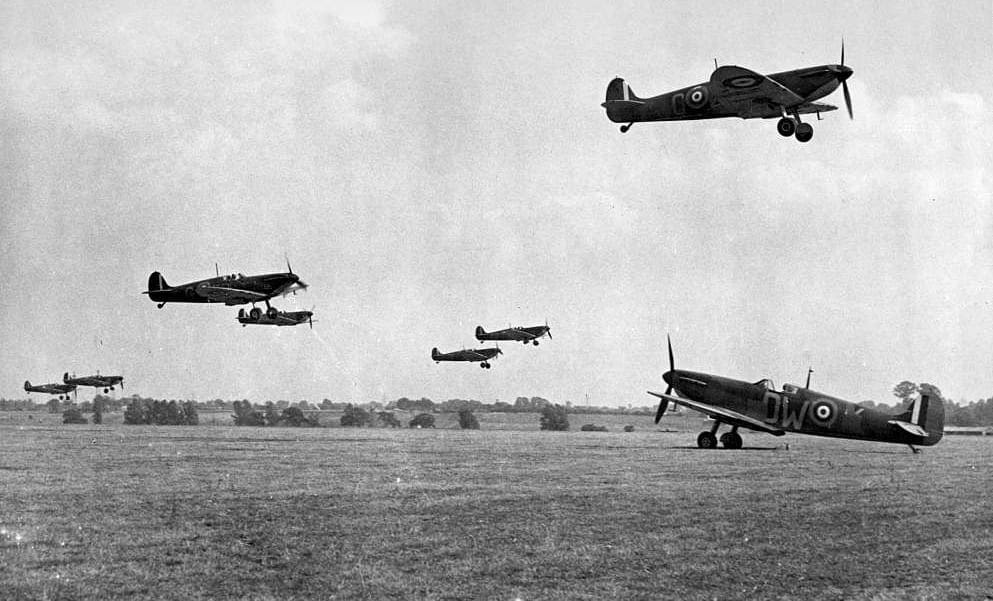
Photo: another type of mishap, the day a steel hawser snapped:

image-30.png


Cutting from 16th October 1954, Airdrie and Coatbridge Advertiser. 

Photo: everything changed in the 1960s with the closure of companies in Glasgow.  In photos from the 1970s and 1980s the decline was obvious:

image-13-1024x683.jpeg


Photo from 1980, taken by Chris Doak (who has kindly agreed I can use it):

image-18-1024x679.jpeg


The special breakfast consisted of: bacon, egg, sausage, black pudding, tattie scone, (baked) beans, a (bread) roll and a mug of tea for £1.  I wonder if the first five items shared a frying pan? 

Today, the Hilton Garden Inn offers breakfast from the same spot, but probably with the same items on offer but possibly not offering the same value for money.

image-15-1024x760.jpeg


In summary, the Stobcross Crane was capable of lifting the heaviest loads in the docks.

  The difference compared to older cranes was not huge but, as important exports like railway engines became heavier over time this might have been important.

Another feature was the length of the cantilever which meant it could load goods into wider ships than a quayside crane which was limited by the length of its jib.

The crane was completed just over 93 years ago but has not been in working order since the late 1980s, so it has been a monument for nearly half of its life (and was probably only intensively used for the first 30 years). 

Sadly, Stuart Cameron comments that little (if any) maintenance is now carried out so, despite being a structure with the highest level of protection, it is in danger of being neglected until it becomes unsafe.  Enjoy the view while you can.

Gazing up at the crane, you might neglect to look down. Just to the west of the Hilton Garden Inn there is a small cobbled car parking area, but that also contains history

 
As it's the 86th anniversary of Battle of Britain Day. In memory of those who served and especially those who made the ultimate sacrifice in the Battle of Britain. Some of the video was recorded in the St. George's RAF Chapel at the World's most famous fighter station, Biggin Hill. I've lost count of the times I've been into the Chapel. Always very moving. Whilst in the Chapel Holland asks if it's a Spitfire or a Hurricane flying over. It was a Spitfire from the neighbouring Heritage Hangar.


Watched this last night. An excellent programme and worth watching. Essentially the programme was in two parts. First part covered the events of 1066 and what happened before and after and touched upon what is portrayed in the Bayeux Tapestry. Speculation about who commissioned it - probably William's half-brother, Odo and where it was made. Probably in Canterbury. The second part covered the logistics of transporting the Tapestry from Bayeux to the British Museum and how it was unfurled and how the exhibition area was setup. I'm visiting the British Museum tomorrow to look at the Tapestry. Am very much looking forward to seeing it.

https://www.bbc.co.uk/iplayer/episode/m00303gc/secrets-of-the-bayeux-tapestry-inside-the-museum

 
Back
Top